A Member of The Association of Graveyard Rabbits

Pages

Thursday, 28 February 2013

Barn Fire Tragedy Kills 78 in 1727


To the Memory of
The 78 People who were Burnt to
Death in a Barn at Burwell.
On Sept. 8th 1727
This stone was Cleaned and 
This Inscription Engraved
Sept: 1910

These two pictures show both sides of the same stone marker

In 1727 a touring Puppet show troupe visited Burwell and was held in a local Barn as many of the villagers turned out with great enthusiasm to view the show. To prevent anyone from getting in without payment, the one small door was nailed shut as the show began. As the blaze tore throught the barn, this act prevented people, many of whom were children, were unable to escape.
The victims of this tragic event are buried in a mass grave and the monument that marks the site depicts a heart enveloped in flames.
   
The following is an extract from the Parish Registers of Burwell:

'At about 9 o'clock on the evening of September 8th 1727, fire broke out in a barn, in which a great number of persons were met together to see a puppet show. In the barn were a great many loads of new light straw. The barn was thatched with straw which was very dry, and the inner roof was covered with old dry cobwebs, so that the fire like lightening flew around the barn in an instant. There was but one small door, which was close nailed up, and could not easily be broken down. When it was opened, the passage was so narrow and everybody so impatient to escape that the door was presently blocked up, and most of those that did escape, which was but very few, were forced to crawl over the bodies of those that lay in a heap by the door.'
'Seventy six perished immediately and two more died of their wounds within two days.'


'The fire was occasioned by the negligence of a servant who set a candle and lanthorne in or near a heap of straw which lay in the barn. The servant's name was Richard Whittaker, from the parish of Hadstock in Essex, who was tried for the fact at an assize held in Cambridge on 27 March 1728 but was acquitted.'

Parisian Puppet Show circa 1910




Tuesday, 26 February 2013

Ashes Scattered on Newmarket Racecourse


In Ever Long Memory
of
William Fleming Carnaby
Squadron Leader R.A.F
Killed on Active Service
Feb 5th 1943
Aged 28 Years
And his Devoted Wife
Mary ~ Nee Sadler
Beloved Mother of Susan & Bill
who died on 18th Oct. 2006
Aged 93 Years
Whose Ashes are Scattered 
on Newmarket Racecourse

Hemingway,Howitt, Marshall JE, Townsend (kneeling with dog Kim) and Carnaby leaning on propeller scoreboard.


William Fleming Carnaby was born on 21st November 1914 at Dulwich, London, he attended Christ's College, Cambridge where he read Economics and Law. 

He learned to fly with the University Air Squadron at Duxford. 
After University, Carnaby went to London and studied to become a Chartered Surveyor with a view to joining his father's firm, Marten and Carnaby.

In late 1935 he joined 601 Squadron Auxiliary Air Force at Hendon and was commissioned in January 1936. Carnaby relinquished this commission on 1st March 1938 for a four-year commission in the Auxiliary Air Force Reserve of Officers. 
On the 31st August 1939 he was called to full-time service and was posted to 264 Squadron, operating Defiants from Duxford. On 7th June Carnaby was flying Defiant which had been damaged over Dunkirk on 29th May. The damage had not been fully repaired and the aircraft went out of control. Carnaby and his gunner, Pilot Officer CC Ellery, were able to bale out but Ellery was seriously injured.

On 28th August Carnaby returned to base with his Defiant severely damaged by return fire from a He111 engaged over Dover. In September he joined 85 Squadron at Castle Camps as it went over to night-fighting.
On 5th February 1943 Carnaby was killed when his  Mosquito of 25 squadron broke up in the air and crashed near Church Fenton. Flying Officer JH Lennox~Kemp was also killed.


Monday, 25 February 2013

Monday Mourning ~ Snowdrops


The Snowdrops ~ Galanthus Nivalis ~ are at their best right now and in abundance in the Churchyard of St. Mary's in the village of Burwell in Cambridgeshire.

Love Flower, hemmed in with snows,
And white as they But hardier for, once more I see thee bend
Thy forehead as if fearful to offend,
Like an unbidden guest...
Chaste Snowdrop, venturous harbinger of Spring
And pensive monitor of fleeting years.
Wordsworth 

Snowdrops are symbolic of consolation as this Legend of their origins tell : 
Eve sat weeping after being expelled from the Garden of Eden because no flowers had bloomed since the Autumn and snow had fallen ceaselessly. An angel came and comforted her and as the angel spoke, he caught a snowflake in his hand and he breathed upon it, it then fell to earth as the first snowdrop. As the flower bloomed, Hope was born.

A German legend tells a different snowdrop story : 
When God made all things on the Earth, He asked the 'Snow' to go to the flowers and get a little color from them. One by one the flowers refused saddened by the other flowers refusals, it asked a snowdrop to give it a little of it's colour and the snowdrop agreed. As a reward, the 'Snow' allows the little flower to bloom first whenever spring shows.

Monks brought snowdrop bulbs from Rome to England and were the first to plant them around old monasteries. 
Because of this snowdrops became known as the church flower. Traditionally on Candlemas ~ 2nd February the image of the Virgin Mary was taken down and a handful of snowdrop blooms were scattered in its place. 

However a single flower indicates impending death and it should never be brought into the house.

Interestingly in October 2010, the UK's National Institute for Clinical Excellence ~ NICE ~ authorised the use of a number of drugs believed to slow the progress of early onset Alzheimer's disease. One of these is Galantamine which was first used, in eastern Europe in the 1950s, to deal with memory impairment. 
NICE said that recent research had shown a cost effective benefit from the drugs.
Galantamine can be extracted from a number of genera, including Galanthus, though Snowdrops are not one of the plants used commercially.


St. Mary's, Burwell.


Thursday, 21 February 2013

The Controversy of a Native New Yorker


Sacred  to the Memory of
William Jauncey of the
City of New York, in the United
States of America, and
Fellow Commoner of St. John's
College, Cambridge
he died November 19th
A.D. 1830 Aged 19 Years

To the Extreme Grief of his Family
and those many Friends whose Esteem
and Affection he had ~ the remainder is unreadable


William Jauncey Thorn was born on the 9th July 1811, he later changed his name by dropping the 'Thorn' and becoming just William Jauncey. 
He attended St.John's College Cambridge in 1830 and he died as a result of a hunting accident, in which he was thrown from his horse and then died the following day as a result of his injuries. 
According to information on the Thorn Family website  it appears that young William Jauncey's body was returned to the USA  in 1856 and that he was interred in the family vault in Greenwood Cemetery, Brooklyn, New York. 

Young William was to have inherited a vast sum upon reaching the age of 21 years from his Mother's Uncle ~ who was also called William Jauncey and who had died in 1818.
 The Will stated: 'I give and bequeath all the residue and remainder of my property, both in England and America, of every kind and description whatever, to the said William Jauncey Thorn, when he arrives to the age of twenty one years, to him, his heirs and assigns forever'.

However soon after young Williams tragic death, a controversy arose when his Father, Colonel Herman Thorn contested the legal effect of the bequest, as it would now be considered to go to other relatives including a niece, Elizabeth Hoyt.

Whilst this case was ongoing, Colonel Thorn compromised the claims of five other relatives by paying them for their interests and then by purchasing Elizabeth's share of the residue at a cost of $6,000. 
When the total amount of the bequest was discovered to be worth $1,465,000, Elizabeth Hoyt claimed that her share had been fraudulently obtained from her and a court case ensued. 
Unfortunately I could find no further outcome of this case.


Monday, 18 February 2013

Champion Flat Racing Jockey


This is the grave of
Elnathan ~ Nat ~ Flatman
1810 ~ 1860
A famous jockey who was known
to be honest, sober, discreet and plain living.
He started as a 15 year old apprentice in
William Cooper's yard. His riding
career began in 1829 and ended in 1859.
He headed the list of top jockeys for
seven consecutive years 1846 to 1852. During
his career he won the 1000 Guineas three times,
the 2000 Guineas three times,
the St.Leger three times, and the Derby once.

Nat Flatman riding Preserve 1835 Painted by John Frederick Herring Jnr.

With the Horse Racing town of Newmarket just half an hour away, I decided to visit the Churchyard of All Saints and the Cemetery there.
So it only seems fitting that my first post from this town should be that of a Champion Jockey.
Elnathan 'Nat' Flatman b. 1810 ~ d.1860 was a British Champion Flat Racing Jockey who began his career as an apprentice at the age of fifteen. By 1840 he was dominating British Racing by winning the Champion Jockey title thirteen years in a row.
During his thirty four year career, he won many important races in England including ten Classics.
In France he was often listed as Edward Flatman and he competed in several major races there. He had three wins in the most prestigious race in France, the Prix du Jockey Club and two wins for filly's in the Prix de Diane.
Nat Flatman retired from racing in 1859 and died the following year and is buried in the Churchyard of All Saints Church.

During his career, Flatman had his portrait painted several times by Artists such as the Equine artist Harry Hall and John Frederick Snr. After his death the town named a Street in Nat Flatman's honour.  

Nat Flatman Street, Newmarket, Suffolk


Saturday, 16 February 2013

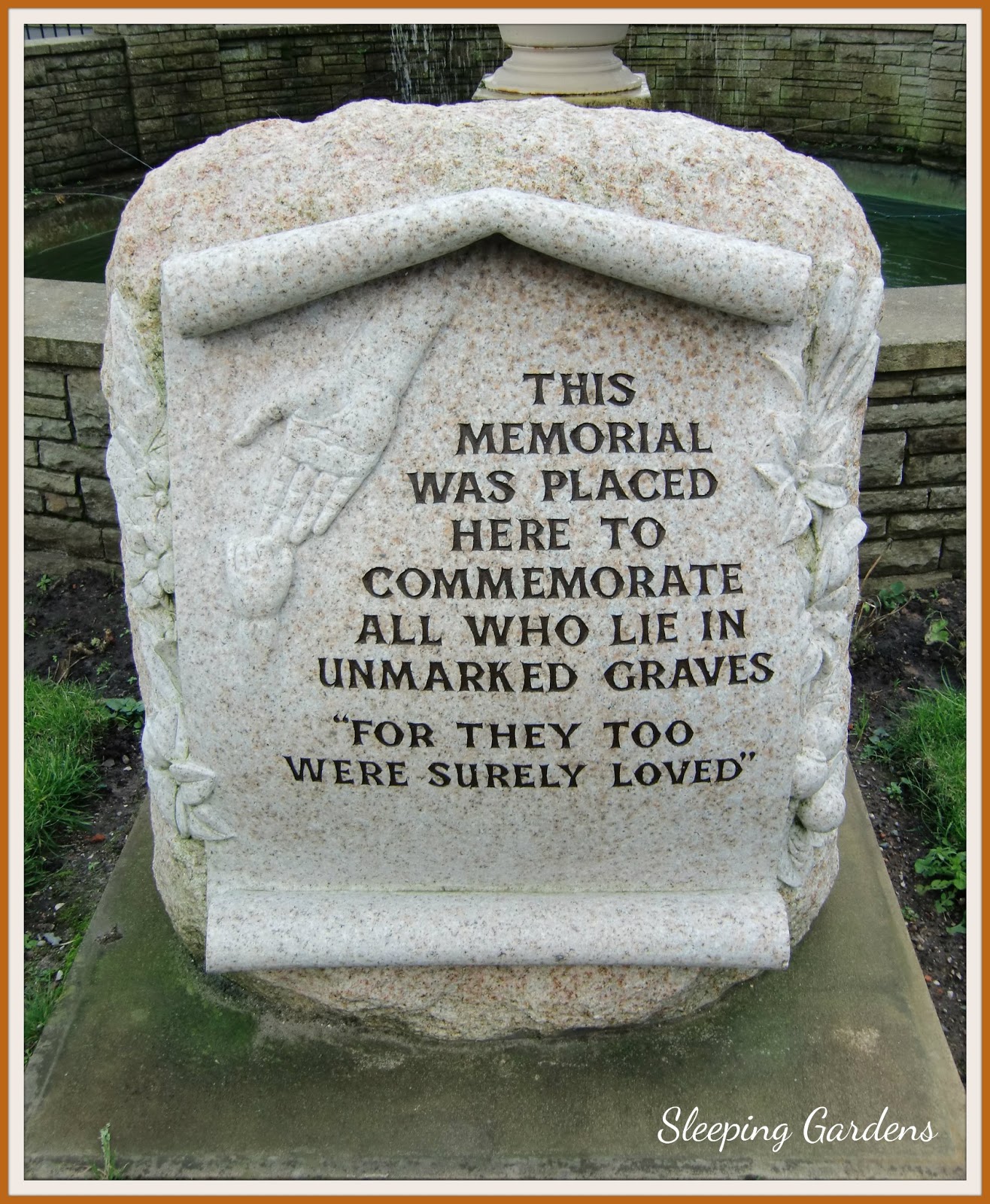
For They Too Were Surely Loved


All too often I see unmarked graves on my visits through Cemeteries and Churchyards and wonder who they were and why they were buried and left unnamed.

To me there is a kind of deeper grief about those who remain nameless and forgotten and because it saddens me that I'm unable to bring their memory and story back to life......

So I was pleased to discover this memorial in Warrington Cemetery, how nice it would be for all our cemeteries to have such a monument for those who do not have one of their own.


Saturday, 9 February 2013

Equerry in Waiting to King George the Fifth


MDCCC LXIV ~ 1864
MDCCC CXXXI ~ 1931
Esse Quam Vederi

Third and Last Baronet of Leasowe
In the County Palatine of Chester
Knight Grand Cross of the Royal
Victorian Order in Waiting 
to His Majesty King George the Fifth
A Captain of the Royal Navy

The headstone is that of Sir Charles Leopold Cust, who was born on the 27th February 1864 and was the 3rd and last of the Cust Baronets when the title became extinct upon his death on the 19th January 1931. 
He served in the Royal Navy on HMS Minotaur, Alexandra and Thunderer and also as the Equerry in Waiting to King George V. He was awarded the following honours GCVO, CB, CMG . 


He rests in the Churchyard of St.Peter and St.Pauls, Belton, Lincolnshire. 


Related Posts Plugin for WordPress, Blogger...