A Member of The Association of Graveyard Rabbits

Pages

Showing posts with label Famous. Show all posts

Friday, 21 February 2014

Saxophone Inventor ~ Adolphe Sax


Adolphe Sax was born on 6th November 1814 in Wallonia, Belgium. His father was an instrument designer and so Adolphe began to make his own instruments at an early age. Adolphe studied music at the Royal Conservatory of Brussels.


Adolphe's first important invention was an improvement of the bass clarinet which he patented at the age of 24.
He moved to Paris in 1841 and began working on a new set of instruments, these valved bugles became so successful that they became known as Saxhorns, with a range of approximately seven sizes in all from Sopranino to subcontrabass and he patented them in 1846. 


He also created the Saxtromba, but this was to survive only briefly and the unsuccessful clarinette~bourdon an early design of contrabass clarinet.

Saxhorn instruments spread rapidly throughout the world and remain largely unchanged today. The British Brass Band movement exclusively adopted the saxhorn range and they are widely used in Concert bands. However they never became a standard Orchestral instrument for which they had been intended to be used.

A plaque on the side of Adolphe Sax's tomb

The saxophone made Adolphe his reputation and secured him a teaching post at the Paris Conservatoire in 1857.
Adolphe suffered from lip cancer between 1853~58 and although he made a full recovery, he died in Paris in 1894.

The Saxophone Family


Belgium's Famous Son is celebrated on currency and postage


A variety of Saxophone styles
Light Jazz Sax ~ Cry me a River ~ Tenor Sax

Ravel ~ Bolero ~ Mi~Bemol Saxophone Ensemble

Piazzolla ~ Libertango ~ The Italian Saxophone Quartet

Rimsky Korsakov ~ Scheherazade ~ Mi~Bemol Saxophone Ensemble

Tex Beneke and the Glenn Miller Orchestra ~ In the Mood


Friday, 14 February 2014

Valentine's Day ~ Serge Gainsbourg ~ 'Je t'aime..'


You can tell by the lipstick kisses and other mementos ~ I once found a cabbage which had a message in Japanese writing on it ! ~ that the admirers of Serge Gainsbourg have an emotional connection to the man who gave us the once controversial song Je t'aime...moi non plus 


Serge Gainsbourg's name at Birth: Lucien Ginsburg ~ 2nd April 1928 ~ 2nd March 1991
Father: Joseph 1898 ~ 1971  Mother: Olga 1894 ~ 1985 

Serge Gainsbourg and Jane Birkin

Although the song was banned in several countries as it gave the impression of two people making love, it reached no.1 in the UK charts in 1969. 


Je t'aime...moi non plus


Friday, 22 November 2013

Benjamin Britten ~ Composer's Centenary


Celebrating 100 years ago today the birth of Benjamin Britten ~ British Composer, Conductor and Pianist. 
Benjamin was born in Lowestoft on the 22nd November 1913 and was the youngest of four children. His father Robert was a dentist and would not allow a gramophone or radio into the house, but his mother Edith was a talented amateur musician and secretary of the Lowestoft Musical Society who held musical soirees at their house.

Benjamin Britten

Benjamin's mother gave him piano lessons and he showed musical talent from an early age. He later studied at the Royal College of Music in London and first came to public attention with a choral work in 1934 with 'A Boy was Born'. Britten leapt to international fame in 1945 with the premier of 'Peter Grimes'.

Peter Pears in 'Peter Grimes'

Over the next 28 years, he wrote 14 more operas and established himself as one of the leading 20th Century composers in that genre. 
Britten's other works included, solo vocal, chamber, orchestral, choral, instrumental and film music. He took great interest in writing music for children and wrote 'The Young Person's Guide to the Orchestra' in 1945.

'Young Person's Guide to the Orchestra' played by the Cologne Philharmonic Orchestra

 Britten would often compose with particular performers in mind and his frequent choice was his personal and professional partner, the tenor Peter Pears.
Britten was also a celebrated pianist and conductor who performed many of his own works as well as those of other composers such as Bach's Brandenburg concertos.

Britten and Pears

Together with Peter Pears and Eric Crozier, Benjamin Britten founded the annual Aldeburgh Festival and was responsible for the creation of the Snape Maltings Concert Hall in 1967. In the last year of Britten's life, he was the first composer to be awarded a life Peerage.
Benjamin Britten died on the 4th December 1976 of heart failure, 10 years later his partner Peter Pears rests eternally by his side in the churchyard of St.Peter and St.Paul in Aldeburgh, Suffolk.


Tuesday, 12 November 2013

Dalida ~ French Singer


Dalida performed and recorded songs in more than 10 languages including: English, Italian, Spanish, Arabic, German, Dutch, Greek, Hebrew and Japanese. Worldwide sales of her music are estimated at over 180 million, establishing her as one of the most noteworthy multi-lingual recording artists of the 20th century.
Dalida was born on the 17th January 1933 and named Yolanda Cristina Gigliotti, her parents were Italian and had emigrated to Cairo, Egypt where her father was the first violinist at the Opera House and it was here in the Italian community that Dalida was born and grew up. 

Destined to a career as a secretary, Dalida secretly entered a beauty pageant and then in 1954 at the age of 20, Dalida won the title and was crowned Miss Egypt. The Cairo film industry opened it's doors to Dalida and it was then that she was spotted by French director Marc de Gastyne. 
Despite her parents reluctance, Dalida moved to Paris which was to become her home for most of her adult life, on Christmas Eve of the same year intending to persue an acting career. It was around this time that she adopted the name Dalida. 


Dalida's singing career began in Egypt, during the early 1950s and due to her limited success in French Cinema, she started taking singing lessons and was booked as a Cabaret act on the Champs~Elysees which proved successful. Dalida’s debut single 'Madona' was a moderate success, however the release of 'Bambino' in 1956 would prove to be triumphant ~ it spent 46 weeks in the French top ten and remains one of the biggest-selling singles in French history. 
Dalida was awarded her first gold disc in September 1957. Dalida toured extensively from 1958 through the early 1960s, playing dates in France, Egypt, Italy, and the United States. Her tours spread her fame outside of France, and Dalida soon became well known throughout Europe. 
Throughout the 1960s Dalida would frequently perform sell-out shows and international dates became more frequent. In December 1968, she was awarded the Médaille de la Présidence de la République by General Charles de Gaulle, the only person from the music industry to have received this medal.


The early 1970s became a transitional period for the singer, highlighted by some of her most successful singles. In 1973, Dalida recorded 'Paroles Paroles' with close friend Alain Delon. The song became a big hit and was the number one single in France, being played consistently on French radio, at the request of listeners. 
Dalida received 55 gold records and she was awarded with the first ever diamond disc. In 1975, French music critics presented the singer with the prestigious Prix de l'Académie du Disque Français.
 A 30-year career ~ she debuted in 1956 and recorded her last album in 1986, a few months before her death ~ this led to an iconic image as a tragic diva and renowned singer. 


Despite her enormously successful career, Dalida's private life was marred by a series of tragedies and personal problems.
In  January 1967, Dalida took part to the Sanremo Festival and sang 'Ciao Amore Ciao' ~ 'Bye Love Bye' ~ with her new lover, Italian singer, songwriter and actor Luigi Tenco. Tenco allegedly committed suicide later the same month after learning that his song had been eliminated from the final competition. Tenco was found in his hotel room with a bullet wound in his left temple and a note announcing that his gesture was against the jury and public's choices during the competition. 
A few days earlier, Tenco's wedding to Dalida had been announced. One month after discovering her lovers body, Dalida attempted to commit suicide by drug overdose in Paris. She spent 5 days in a coma and several months convalescing, only going back to the stage the following October.
In December 1967, just after her first suicide attempt, she became pregnant by an 18-year-old Italian student, Dalida decided to terminate the pregnancy but sadly the surgery left her infertile.


In September 1970, her former lover from 1956 to 1961 and former husband Lucien Morisse, with whom she was still on good terms, committed suicide by shooting himself in the head.
From 1969 to 1971, Dalida's had a relationship with philosopher and writer Arnaud Desjardins, the couple split as he was still married.

In November 1974 her close friend, singer Mike Brant first attempted suicide and Dalida was the first to visit him in hospital. In April 1975, he jumped to his death from an apartment in Paris. He was 28.
In July 1983, her lover from 1972 to 1981, Richard Chanfray, committed suicide by inhaling the exhaust fumes of his car.
Dalida, then had brief encounters with a sound technician, a lawyer, an Egyptian jumbo jet pilot and a French doctor during the period 1983-1986.
1987 Trying to cope with her personal demons, Dalida is back in the studio recording new songs. One night coming home she finds her beloved dog dead.


Sadly on Saturday, 2 May 1987, Dalida tragically committed suicide by overdosing on barbiturates. She left behind a note which read,
 'La vie m'est insupportable... Pardonnez-moi.' ~ Life has become unbearable for me... Forgive me.

Place Dalida in the 18th Arrondissment is named after this beloved chanteuse, not far from where she lived.


For more information on Dalida Click here 


Tuesday, 4 June 2013

Great British Cemeteries ~ Warstone Lane ~ Birmingham


Warstone Lane Cemetery was owned by the Church of England Cemetery Company and was opened in 1848 for Anglicans and Nonconformists and is located in the City's Jewellery Quarter. It was acquired by the Birmingham City Council under a compulsory purchase order in 1951. 
The Cemetery lodge which is built from Staffordshire Blue Stone is a Grade II listed building and are now privately owned offices. 
The cemetery's name and several of the surrounding streets, comes from the 'War Stone' that was deposited by a glacier during the Ice Age and which served as a Parish boundary marker. However the cemetery has also been known by other names, such as Brookfields Cemetery and The Mint Cemetery, due to it's close proximity to the coin producing 'Mint'  nearby.   


The War Stone
This felsite boulder was deposited near here
by a glacier during the Ice Age: being at one 
time used as a parish boundary mark, it
was known as the 'Hoar Stone' of which the
modern War Stone is a corruption.


The cemetery's memorial chapel of St.Michael's was used for worship from 1854 to 1878. The chapel stood above the semi~circular rows of catacombs, which made use of the features of the site after it had previously been used as a sandpit quarry.
Coffins were lowered from the chapel above down into the catacombs below by way of a  catafalque
In 1846 the Birmingham Cemeteries Act required all coffins interred within the catacombs to be sealed with lead or pitch, due to the 'Unhealthy vapours and unpleasant smell emanating from them'.
The catacombs which had previously been accessible when vacant, have now all been sealed due to becoming the unsavoury haunt of drug users and rent boys.


Sadly the church fell into disuse and was demolished in 1953. 


The retaining walls of the catacombs require additional support until further work can be undertaken to strengthen them. 
   

Although the cemetery is no longer open for new burials here are some of the Notable people interred in Warstone Lane :

John Baskerville , Printer, Typographer and Japanner
Major 'Harry' Gem. Co~founder of Lawn Tennis
William Chance, Glass Manufacturer
Private James Cooper, Awarded the VC 
Clement Ingleby, Solicitor and Poet 
John Postgate, Food Safety Campaigner
Dr Pye Chavasse, Medical Guides Author
Joseph Allday, Radical Politician
Thomas Scarrott, Fought at the Battle of Waterloo

 For more old photographs of Warstone Lane Cemetery click on the link below


Monday, 18 February 2013

Champion Flat Racing Jockey


This is the grave of
Elnathan ~ Nat ~ Flatman
1810 ~ 1860
A famous jockey who was known
to be honest, sober, discreet and plain living.
He started as a 15 year old apprentice in
William Cooper's yard. His riding
career began in 1829 and ended in 1859.
He headed the list of top jockeys for
seven consecutive years 1846 to 1852. During
his career he won the 1000 Guineas three times,
the 2000 Guineas three times,
the St.Leger three times, and the Derby once.

Nat Flatman riding Preserve 1835 Painted by John Frederick Herring Jnr.

With the Horse Racing town of Newmarket just half an hour away, I decided to visit the Churchyard of All Saints and the Cemetery there.
So it only seems fitting that my first post from this town should be that of a Champion Jockey.
Elnathan 'Nat' Flatman b. 1810 ~ d.1860 was a British Champion Flat Racing Jockey who began his career as an apprentice at the age of fifteen. By 1840 he was dominating British Racing by winning the Champion Jockey title thirteen years in a row.
During his thirty four year career, he won many important races in England including ten Classics.
In France he was often listed as Edward Flatman and he competed in several major races there. He had three wins in the most prestigious race in France, the Prix du Jockey Club and two wins for filly's in the Prix de Diane.
Nat Flatman retired from racing in 1859 and died the following year and is buried in the Churchyard of All Saints Church.

During his career, Flatman had his portrait painted several times by Artists such as the Equine artist Harry Hall and John Frederick Snr. After his death the town named a Street in Nat Flatman's honour.  

Nat Flatman Street, Newmarket, Suffolk


Tuesday, 29 January 2013

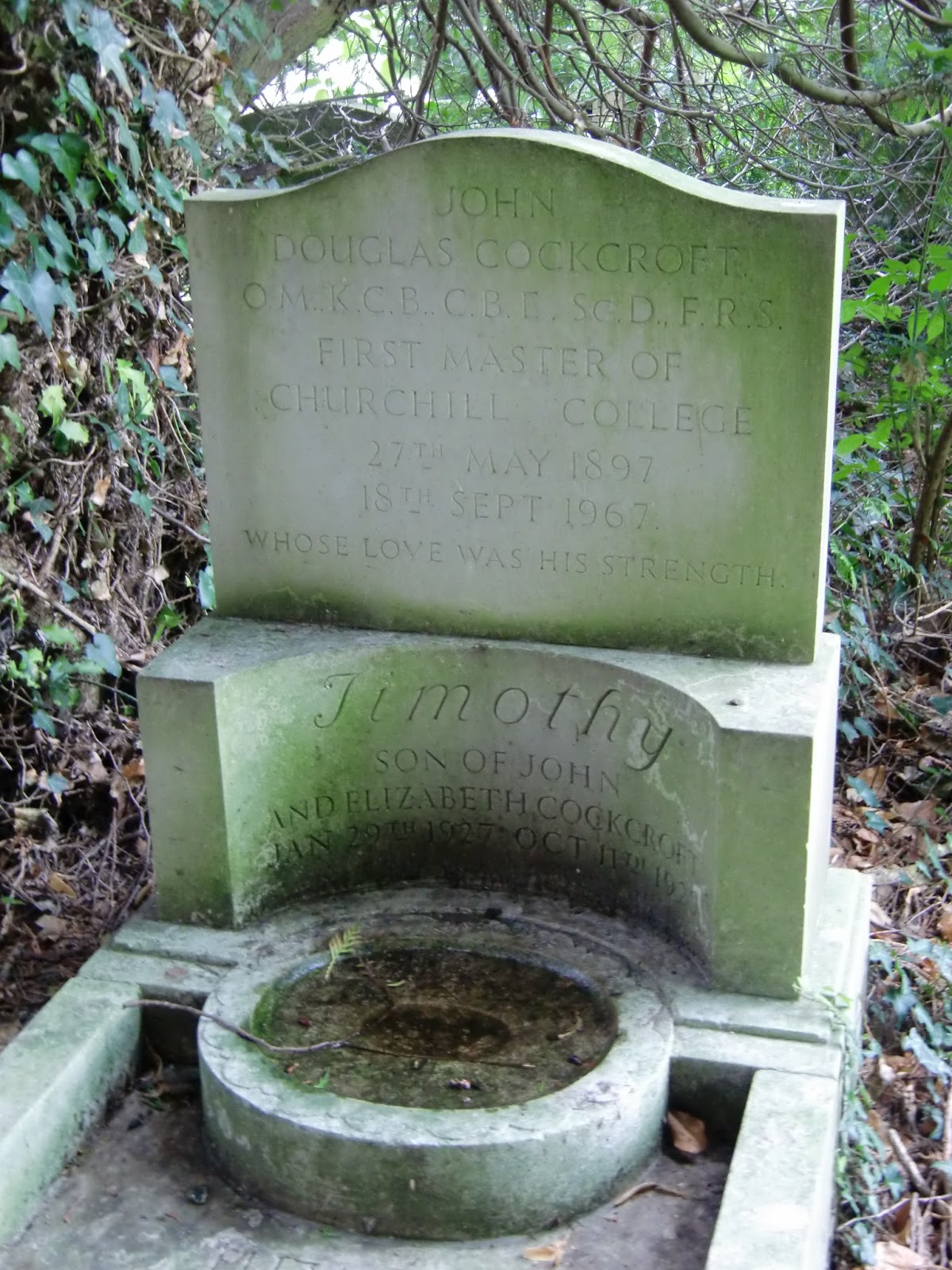
Nobel Laureate ~ John Cockcroft


John 
Douglas Cockcroft
O.M K.C.B C.B.E Sc.D F.R.S
First Master of
Churchill College
27th May 1897
18th Sept 1967
Whose love was his strength
Timothy
son of John
and Elizabeth Cockcroft
Jan 26th 1927 Oct 11th 1929
Elizabeth
Beloved Wife
Loving Mother
Oct 26th 1898
Aug 4th 1989


John Douglas Cockcroft was a British Physicist who shared the Nobel Prize in Physics for splitting the Atomic Nucleus with Ernest Walton in 1951. Cockcroft was instrumental in the development of Nuclear Power.

John was born on 27th May 1897 at Todmorden, W.Yorkshire, England. His family had been Cotton Manufacturers for several generations.
He studied mathematics at Manchester University in 1914 and served as a Signaller in the Royal Field Artillery during the First World War. He then returned to Manchester and studied electrical engineering and after an apprenticeship with Metropolitan Vickers Electrical Co. he went to St. John's College Cambridge and took the Mathematical Tripos in 1924 and became a Fellow of St.John's in 1929.

In 1925 he married Eunice Elizabeth Crabtree and had six children, John Haslam ~ known as Timothy was born 29th January 1927 ~ 86 years ago today, but died at the age of two years old. He is buried with his Father and Mother in the Ascension Burial Ground, Cambridge.
John and Elizabeth had four daughters and another son. 

He worked on the acceleration of protons in 1928 and was joined by Ernest Walton. 
In 1929 he became a Fellow at St.John's and in 1939, Jacksonian Professor of Philosophy.
In that same year he took a war~time appointment as Assistant of Scientific Research in the Ministry of Supply and started work on Radar to Coast and Air Defence problems. After which he was appointed Head of the Air Defence Research and Development Establishment.

In 1944 he went to Canada and took charge of the Canadian Atomic Energy Project and returned to England in 1946 as Director of the Atomic Energy Research Establishment at Harwell. From 1954 to 1959 he was scientific research member of the U.K. Atomic Energy Authority.
In 1959 he became First Master at Churchill College, Cambridge and Chancellor of the Australian National University, Canberra. From 1960 to 1962 he was President of the Institute of Physics, the Physical Society and that of the British Association for the Advancement of Science from 1961 to 1963.
John Cockcroft recieved honorary doctorates from some 19 Universities and a fellow or honorary member of many Principal Scientific Societies.        


Friday, 25 January 2013

Nobel Laureate ~ George Paget Thomson


George Paget Thomson
K.T   F.R.S
1892 ~ 1975
Scientist Nobel Laureate
Master of Corpus Christi 
and his wife
Kathleen Buchanan Thomson
1900 ~ 1941
Daughter of
Rt Rev. Sir George Adam Smith


George Paget Thomsom was jointly awarded the Nobel Prize for Physics in 1937 for his work in discovering the wave like properties of the electron. The prize was jointly shared with Clinton Joseph Daivsson who made the same discovery independently.

George was born in Cambridge on 3rd May 1892. He was the son of Physicist and Nobel Laureate J.J. Thomson ~ who had won his Nobel Prize for discovering the electron as a particle.
George read Mathematics and Physics at Trinity College, Cambridge. When World War One broke out in 1914 he was commissioned into the Queen's Royal West Surrey Regiment. After service in France, he became a Fellow at Cambridge. 
  

In 1924, George married Kathleen Buchanan Smith, daughter of the Very Reverend Sir George Adam Smith. They had four children, two sons and two daughters.
In 1930 George Paget Thomson was appointed Professor at Imperial College and in the late 1930's during the Second World War he specialised in Nuclear Physics and as a chairman of the 'Maud Commitee' in 1940 ~ 1941 he concluded that an Atomic Bomb was feasible.

In later life he continued this work on Nuclear Energy and also wrote works on aerodynamics and the value of Science in society.
George stayed at Imperial College until 1952 and became Master of Corpus Christi College, Cambridge. He was Knighted in 1943 and died on the 10th September 1975 and is buried in the Churchyard of St. Andrew and St. Mary in Granchester, Cambridge. 


Monday, 21 January 2013

Monday Mourning ~ Jolly Jumbo


In Loving Memory 
of
my Beloved Husband
 William Thomas Ecclestone
who Departed this Life
April 5th 1915 Aged 52 Years
Long days and nights he bore his pain
To wait for cure but all in vain
Till God above saw what was best
And took him home and gave him rest
Also Anne
Beloved wife of
Sol Goodman
who fell asleep May 22nd 1955
aged 89 Years
May her dear soul rest in peace


William Thomas Ecclestone was affectionately known as Jolly Jumbo, he weighed 38 stone and was regarded as 'The Second Heaviest Man in the World' at that time.
He was the owner of the Canterbury Arms Public House in West Kilburn, London and a local celebrity who needed a special pony and trap to move around in.
It is with some irony, that as a young man in the Army, he introduced exercises so effective that they became standard training and he later became a renown trainer of runners and boxers in the area.

Picture Taken Circa 1910 ~ Right to Left
Liver Davis ~ trainer: Jimmy Walsh ~ Bantam Weight Champion: Jolly Jumbo: 
Jack L.... : Unknown

Click on the Bold type above for more information on Sam Langford


Related Posts Plugin for WordPress, Blogger...