A Member of The Association of Graveyard Rabbits

Pages

Showing posts with label Cambridgeshire. Show all posts

Tuesday, 30 April 2013

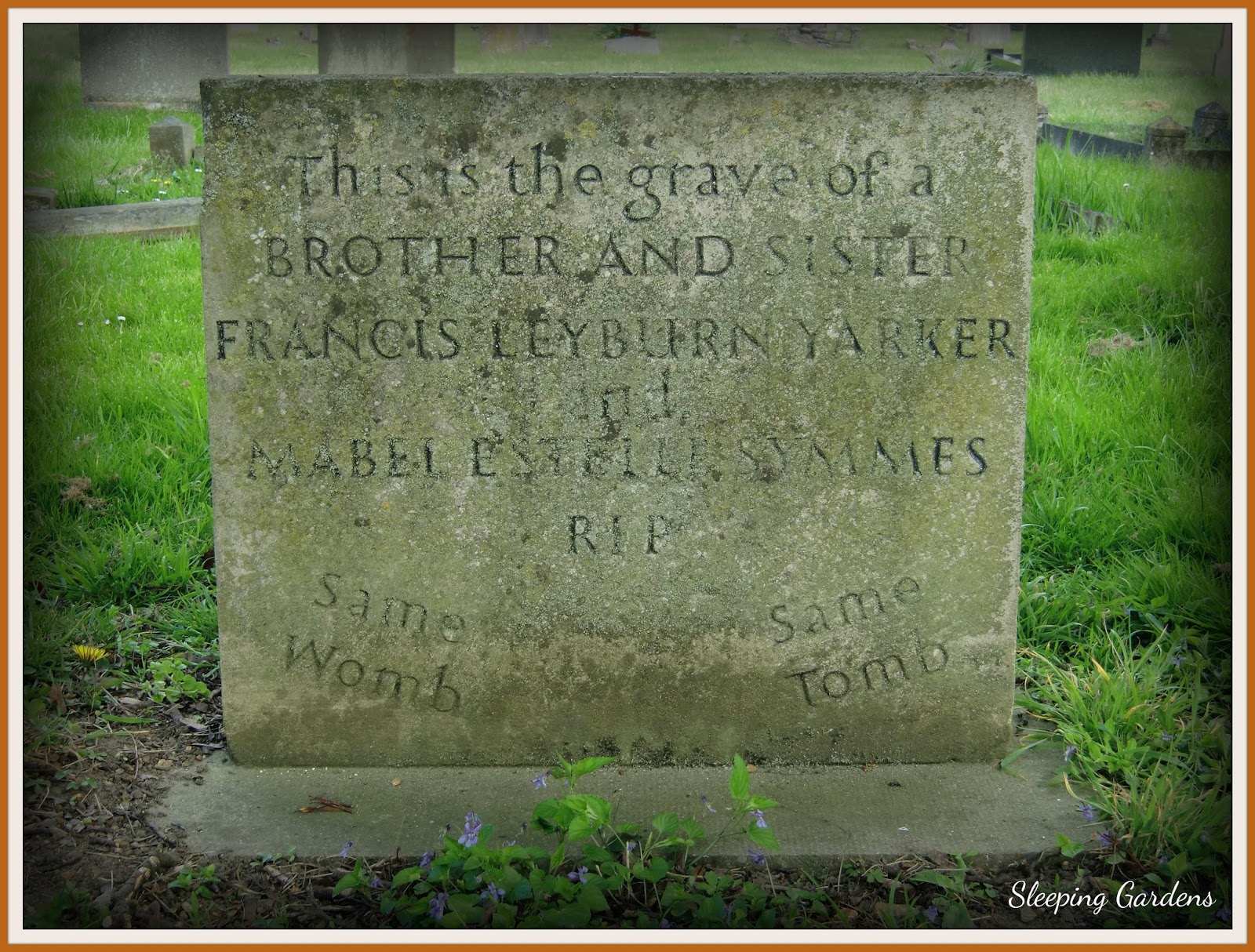
Same Womb ~ Same Tomb


This is the grave of a
Brother and Sister
Francis Leyburn Yarker
and
Mabel Estelle Symmes
RIP
Same Womb  ~  Same Tomb

When I first saw this Epitaph, I couldn't help thinking that it was a little bit unsettling.

Arnold Francis Yarker ~ born in 1847, died 1896 ~ and Cecillia Mary Tully ~ born 1855 ~ were married in 1868. 
They had two children, a daughter Mabel Estelle ~ born in 1873 and a son Francis Leyburn ~ born in 1876 ~ who became a Private Law Tutor and who died in 1911 aged 35 years old.
It seems to appear by the change of surname that Mabel must have married, but I could not find any further information about her.

If they had not previously chosen to be buried together with this strange Epitaph, 
I wonder who did choose it and why ?.


Saturday, 13 April 2013

Regency Style Tombstones


John Winston  ~  John Winston
Is the most legible name on both of these stones, but it looks as though another name beginning with the letter 'M' appears above it on the left, all other information on these stones is not fully legible


On first appearances the inscriptions on these headstones look as though they could be easily read, but the lichen has made it almost impossible.
I believe these headstones to be in a Regency Style and whilst I have seen others of this period with flaming urns and obelisks, I have not seen them carved in such deep relief and in so much detail. I especially like the round name plate which appears to be hanging on the obelisk, shame it's not now legible.
The name Mr. John Winston appears on both headstones, but as is often the practice, a husbands name may appear larger than that of his wife's, even when it is her monument. Mr. Winston must have been a wealthy man, as these monuments are grandly embellished and also because they are quite close to the church door ~ prime location was more desirable and so came at a higher cost.

 St. Mary's Church, Eaton Socon, Cambridge


Monday, 25 February 2013

Monday Mourning ~ Snowdrops


The Snowdrops ~ Galanthus Nivalis ~ are at their best right now and in abundance in the Churchyard of St. Mary's in the village of Burwell in Cambridgeshire.

Love Flower, hemmed in with snows,
And white as they But hardier for, once more I see thee bend
Thy forehead as if fearful to offend,
Like an unbidden guest...
Chaste Snowdrop, venturous harbinger of Spring
And pensive monitor of fleeting years.
Wordsworth 

Snowdrops are symbolic of consolation as this Legend of their origins tell : 
Eve sat weeping after being expelled from the Garden of Eden because no flowers had bloomed since the Autumn and snow had fallen ceaselessly. An angel came and comforted her and as the angel spoke, he caught a snowflake in his hand and he breathed upon it, it then fell to earth as the first snowdrop. As the flower bloomed, Hope was born.

A German legend tells a different snowdrop story : 
When God made all things on the Earth, He asked the 'Snow' to go to the flowers and get a little color from them. One by one the flowers refused saddened by the other flowers refusals, it asked a snowdrop to give it a little of it's colour and the snowdrop agreed. As a reward, the 'Snow' allows the little flower to bloom first whenever spring shows.

Monks brought snowdrop bulbs from Rome to England and were the first to plant them around old monasteries. 
Because of this snowdrops became known as the church flower. Traditionally on Candlemas ~ 2nd February the image of the Virgin Mary was taken down and a handful of snowdrop blooms were scattered in its place. 

However a single flower indicates impending death and it should never be brought into the house.

Interestingly in October 2010, the UK's National Institute for Clinical Excellence ~ NICE ~ authorised the use of a number of drugs believed to slow the progress of early onset Alzheimer's disease. One of these is Galantamine which was first used, in eastern Europe in the 1950s, to deal with memory impairment. 
NICE said that recent research had shown a cost effective benefit from the drugs.
Galantamine can be extracted from a number of genera, including Galanthus, though Snowdrops are not one of the plants used commercially.


St. Mary's, Burwell.


Related Posts Plugin for WordPress, Blogger...