A Member of The Association of Graveyard Rabbits

Pages

Friday, 12 August 2011

Friday's Funerary Art ~ Art Nouveau


The Art Nouveau style was most popular from 1890 ~ 1905, with it's elegant free flowing lines and graceful curves that swirl around stylized shapes and flowers. 
This Art Nouveau monument for the Family of the Trader, Ernest Caillat 1839~1899. It is said to have been designed by Hector Guimard, who was primarily an architect and designer, known mainly for his famous Metro underground train entrances in Paris.

He also designed villas, town houses and tenements and also created the interior decorations, furniture and other objects in this style.


We visited Pere~lachaise in Paris, about 10 years ago and unfortunately my camera was not a digital one then, so my pictures need to be scanned first and sometimes the quality is rather poor !

That sounds like the perfect excuse to re~visit


Wednesday, 10 August 2011

Wednesday's Child


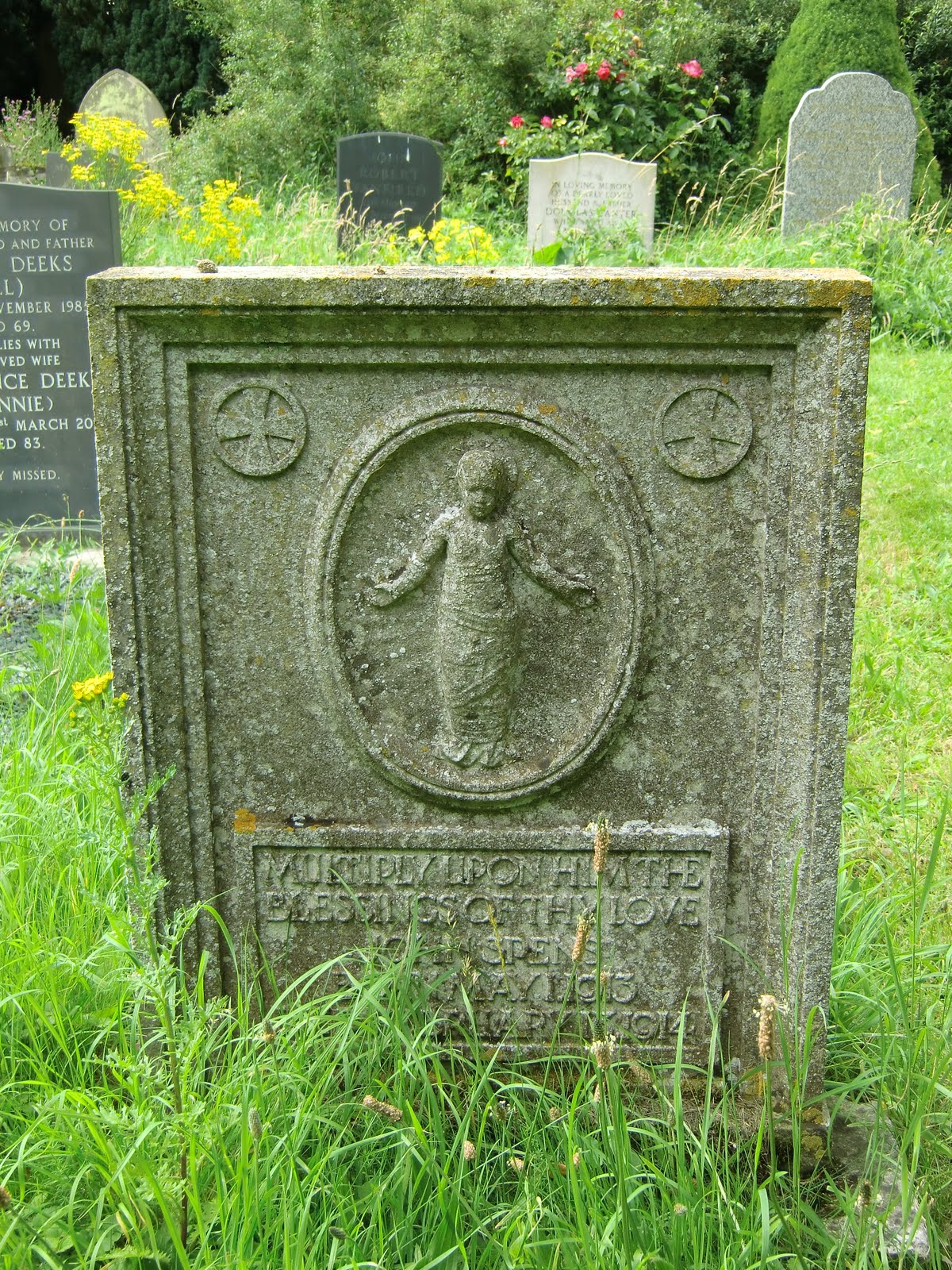
Multiply Upon Him The
Blessings of Thy Love
John Spens
Born May 1st 1913
Died February 13th 1914

I was rather excited about this recent find in the Ascension Burial Ground in Cambridge, because I have not seen a relief of a baby wrapped in swaddling bands like this before.
Also I believe that the circular crosses in the corners of the headstone represent Canterbury Cross, which are used by the Anglican Church, and this Burial ground was formerly that of St.Gile's and St. Peter's Parish.


Saturday, 6 August 2011

What the Ivy Revealed


I love the Gothic atmosphere, that Ivy running wild can bring to the monuments in an old cemetery. It seems to add it's own contrasting message to the unchanging stillness and silence of the sentinal stones, reminding us that life is continually moving forward.


Having appreciated that though.....
I just had to peel it back to see what it would reveal underneath


A beautiful but sadly broken lily bud, before it had the time to blossom.


Friday, 5 August 2011

Friday's Funerary Art ~ Art Deco Styles


The following monuments are in the Art Deco style, which reached it's peak during the 1930's, with it's geometric streamlined patterns and shapes. This style was applied to almost everything of that era, architecture, transport, furniture, household items and also included fashion and hairstyles.


It's interesting to see the similarity between this building in Los Angeles, and the monument above it from Southend~on~Sea in England.


And this monument in Llandudno in Wales, reminds me of the iconic Chrysler building in New York. 


Even though the headstone is a simple one, this Art Deco vase below reflecs the style of those times.


Thursday, 4 August 2011

Angels Guided Her To Heaven


In Loving Memory of our darling
Ivy Grace
the dearly beloved and only child of Charles & Daphne Brown
Born, Gold Mohur Castle, Bombay, 14th December 1886
Died at Limpley Lodge, Llandudno 7th April 1907

Who plucked this flower ? The Master !
And the Gardener held his peace

Weep not for death ! the fount of tears is sealed;
Who knows how bright the inward light
To those closed eyes revealed ~
Who knows what Holy love may fill
The heart that seems so cold and still 

~~~~

Also in Loving Memory
of her Father
Charles Campbell Brown
who died at Weymouth
19th Jan. 1916 in his 59th year

God's Finger touched him and he slept.


Wednesday, 3 August 2011

Wednesday's Child


In Loving Memory of
our Darling
Keith Dodds
who fell asleep Feb. 1st 1941
aged 5 years 11 months
'An Angel Lent'


Monday, 1 August 2011

Monday Mourning ~ Tomb Styles

Coffin Tomb


The Coffin tomb has a main body that is coffin shaped and the three above also have head and foot stones. The ones pictured here all belong to the same family and the smaller one in the middle contains two children of that family.


Here is another example of Coffin tombs from the same churchyard, where the main stone has a rounded top and is a tapered coffin shape, these examples also have head and foot stones as well.  
   

The Coffin tombs above are in the Churchyard of Holy Trinity, a Church of England parish church in Rayleigh, Essex. A church has existed on this site since Saxon times and the present building has a Norman chancel. The bell tower was built in the 15th century and includes stone taken from the castle when that fell into disuse. The church has an impressive Tudor brick porch. The Gothic Revival architect, C.C. Rolfe restored the chancel in 1873.

More coffin tombs, this time from St.Mary's Church in Saffron Walden, Essex.


Related Posts Plugin for WordPress, Blogger...