A Member of The Association of Graveyard Rabbits

Pages

Showing posts with label Wales. Show all posts

Tuesday, 9 April 2013

Five Cherubs


And
With the 
Morn
Those
Angel Faces
Sleep
In 
Loving Memory
Edward Thomas Harris
The Beloved Husband of Elizabeth Harris
St. Tudno's  Gt. Orme
Born ~ unreadable
Died July 2?th 1915 


When I saw Laurie's recent post at Graveyard Detective I recognised it and straight away I knew that I had a  photograph very similar to his one. 
So just like playing the children's card game of 'Snap' here is my offering.
However I think that I can 'trump' yours Laurie with my five cherubs to your three.....

Click on the bold type link above to see Laurie's post.


Friday, 5 August 2011

Friday's Funerary Art ~ Art Deco Styles


The following monuments are in the Art Deco style, which reached it's peak during the 1930's, with it's geometric streamlined patterns and shapes. This style was applied to almost everything of that era, architecture, transport, furniture, household items and also included fashion and hairstyles.


It's interesting to see the similarity between this building in Los Angeles, and the monument above it from Southend~on~Sea in England.


And this monument in Llandudno in Wales, reminds me of the iconic Chrysler building in New York. 


Even though the headstone is a simple one, this Art Deco vase below reflecs the style of those times.


Thursday, 4 August 2011

Angels Guided Her To Heaven


In Loving Memory of our darling
Ivy Grace
the dearly beloved and only child of Charles & Daphne Brown
Born, Gold Mohur Castle, Bombay, 14th December 1886
Died at Limpley Lodge, Llandudno 7th April 1907

Who plucked this flower ? The Master !
And the Gardener held his peace

Weep not for death ! the fount of tears is sealed;
Who knows how bright the inward light
To those closed eyes revealed ~
Who knows what Holy love may fill
The heart that seems so cold and still 

~~~~

Also in Loving Memory
of her Father
Charles Campbell Brown
who died at Weymouth
19th Jan. 1916 in his 59th year

God's Finger touched him and he slept.


Monday, 4 July 2011

Monday Mourning ~ Tomb Styles

Sarcophagus Tomb

Llandudno, Wales

The Sarcophagus tomb has the appearance that it contains the actual body of the departed, however the is not the case, as the body would be interred in a vault below ground. The Sarcophagus style may be simple as these examples here, or very ornate indeed, a common main feature is that the main body of the tomb is tapered towards the bottom and that it stands upon feet, which can often appear to be those of a lion. 

Brompton Cemetery, London

Bunhill Field, London


Wednesday, 29 June 2011

Wednesday's Children ~ Killed at Roadworks

In Affectionate
Remeberance of
the children of
Robert and Ellen Roberts
of this town
Anne Jane, died March 14th 1867
Aged 9 months
Arthur, died September 1st 1870
Aged 8 months
Rowland, Killed at Stafford
RoadWorks, Wolverhampton
January 14th 1873
Aged 18 years and 9 months
Evan, died March 11th 1873
Aged 15 years
W.C. Arridge Roberts
born Feb 4th 1896
died June 11th 1896
Gone, but not forgotten


Friday, 17 June 2011

Fridays Funerary Symbols ~ Curtains

The symbolism of Curtains or Drapes, represents the divide between the world of the living and that of the next, as in the saying ~ Beyond the Veil. Whilst the purpose of a curtain may be that of concealment, it may also be used as a form of protection.
The veil that covered the Ark of the Covenant, was intended to protect mortals from its radiance.
I had not seen such good examples of Curtains until I found these two similar examples.
Surprisingly I found them on the same day, the first one in Wales and the other in England.
  

In Loving Memory of
Elizabeth
the beloved wife of
Benjamin Jones
Green Bank, Augusta St., Llandudno
who died August 17th 1897
Aged 57 years
also of
Benjamin Jones
Died ~ to worn to read
also of
Eliza Jane Evans
Died Jan. 18th 1928
Aged 62 years 

 In Loving Memory of
Sarah Ellen
the dearly beloved daughter of
Andrew & Rachel
Millinger
born January 15th 1872
died August 21st 1875
Jesus called a little child unto him
Thomas Alfred
their dearly beloved son
born May16th 1877 died May17th 1899
Thy Will Be Done
Rachel
the dearly beloved wife of
Andrew Millinger
born June 13th 1844 died October 1918
He giveth his beloved sleep
Also the above named
Andrew Millinger
died April ?  Aged 87 years


Monday, 13 June 2011

Monday Mourning ~ Dolgarrog Disaster


In Loving Memory of
John Stanley Taylor
1 Machno Terrace, Dolgarrog
Aged 29 years
also of
Dorothy Buddug
his wife
Aged 24 years
and
Sylvia Doris
their daughter
Aged 17 months
who lost their lives in the
Dolgarrog Disaster on
November 2nd 1925
The Lord gave and the Lord hath taken away
Blessed be the name of the Lord

On the night of the 2nd of November 1925, the failure of two dams caused a flood that swamped the village of Dolgarrog, killing 16 people. Many more villagers could have been killed had they not been in the local theatre watching a film that night.
The disaster was started by the failure of the Eigiau Dam, a gravity dam owned by the Aluminium Corporation.
The water released from the reservoir flooded downstream, and overtopped the Coedty Dam, an embankment dam. This dam also subsequently failed, releasing the huge volume of water that flooded Dolgarrog.


The disaster at Dolgarrog led the British parliament to pass the Reservoirs ~ Safety Provisions ~ Act in 1930 that introduced laws on the safety of reservoirs. This has since been updated, and the current one is the Reservoirs Act, 1975.


In 2004 a £60,000 memorial trail was created, explaining the tragic story to walkers. The trail takes visitors to where the boulders from the damaged dam reside. The project was opened by the last survivor of the dam disaster, Fred Brown, who on that night lost his mother and his younger sister.


Click the bold type link below to see archive footage of the disaster


Friday, 10 June 2011

Winged Wheel


In loving memory
of
Beatrice Blore Browne ( Bee )
Born September 26th 1887
Died November 23rd 1921
She feared naught but God

Beatrice ~ Bee ~ was born in Middlesbrough, Yorkshire and died in
Delamere, Penmaenmawr at the age of 34 years old.
Beatrice became a maverick of her time, when she drove a Singer 10hp car up the Old Road on the Great Orme circa 1911. It drew the attention of the press and onlookers, who wondered whether she would make it.


It may have been this, that drew the attention of George Wilkins Browne.
In December 1920, he became the first person to drive a car both up and down Snowdon. He drove up and down the railway track in an Angus Sanderson 14hp car. This event was filmed for cinema audiences. The ascent took 1 hour 22 mins, the descent 1 hour 5 mins.

The link below shows a Pathe Film of the event at the same time.
Driving up Snowdon in the 1920's  

In 1920, Beatrice Blore changed her name by deed poll and added the surname of Browne. Her death in November 1921 at the early age of 34, was due to cancer of the liver and breast, which she had been been suffering from for the previous two years.
Her unique gravestone has kept her memory alive, a reminder of a woman keen to push the boundaries of what it was considered acceptable for women to do.


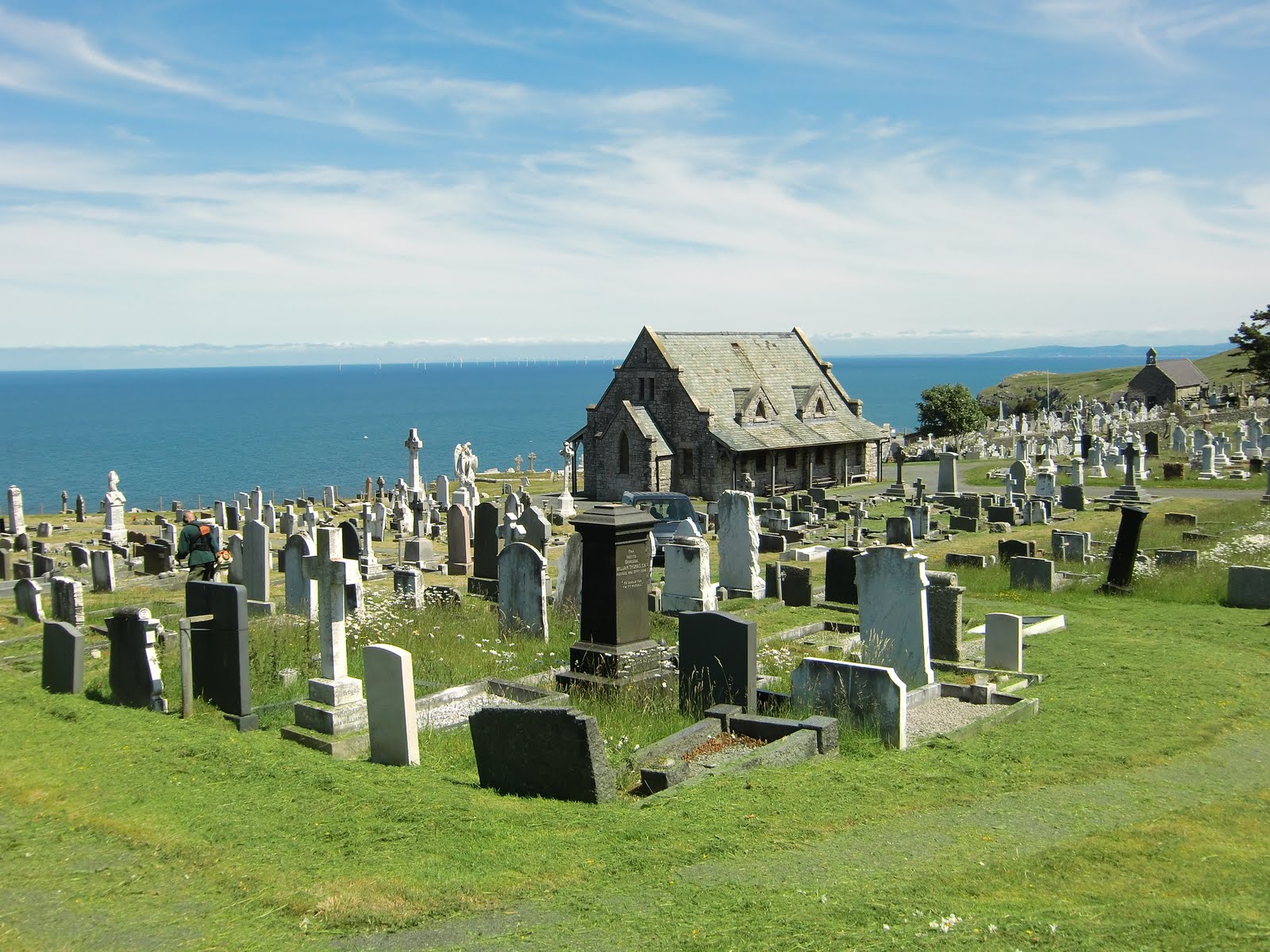
Cemeteries of the World ~ Great Orme, Llandudno ~ Wales


The cemetery on the Great Orme, Llandudno, Wales and the adjoining churchyard of St. Tudno are well worthy of a mention in 'Cemeteries of the World', if for no other reason than 'Location, Location, Location'. 
And a few really interesting finds......


St.Tudno ~ pronounced Tidno ~ was a 6th century Celtic Monk, who climbed the Welsh, windswept headland of the Great Orme, to spread the message of Christianity and this place has been an active site of worship ever since.


Open air services are held on Sundays from the end of May until the end of September.


The outdoor pulpit stands on some very large plate tombstones, so often seen in the aisles of English Churches.

After discovering this place last year whilst on holiday, my parents said they knew
I would just love this cemetery and so we arranged a family day out 'graveyard stomping' ~ a term I have adopted from Corin White's blog Adventures of a Gravestomper. The already sloping and uneven ground of this cemetery, makes nagivating between the stones all the more challenging and so you really have to watch where you tread.We noticed what appeared to be quite a few other people looking around this interesting place ~ cemetery tourists ~ rather than the usual visitor, who comes to see a loved one.


I shall be posting some of my finds in the very near future, so watch this space.......


Sunday, 26 December 2010

The Holly and the Ivy........

Sacred Cemetery Trees


Holly's significance as a Christian symbol, is connected to it's prickly leaves and likened with Jesus' crown of thorns and the berries with the drops of blood shed for humanity's salvation, as related to in the Christmas carol, 'The Holly and the Ivy'.
Yet even here the reference to these two plants refers to a pre-Christian celebration, where a boy would be dressed in a suit of holly leaves and a girl similarly in ivy, to parade around the village, bringing Nature through the darkest part of the year to re-emerge for another year's fertility.
Like several other native trees it was felt to have protective properties, and there were taboos against cutting down a whole tree. Hollies were frequently left uncut in hedges when these were trimmed. A more arcane reason for this was to obstruct witches who were known to run along the tops of hedges.

The yew tree was another sacred tree of the Druids in pre-Christian times. They possibly observed the tree's qualities of longevity and regeneration (drooping branches of old yew trees can root and form new trunks where they touch the ground), and the yew came to symbolise death and resurrection in Celtic culture.
They will also have been familiar with the toxicity of the tree's needles in particular, which can prove fatal, and which may have further contributed to its connections with death.
The themes of death and resurrection continued into the Christian era, with the custom of yew shoots being buried with the deceased, and boughs of yew being used as 'Palms' in church at Easter. Yew trees have in fact established a popular association with old churches in Britain, to the extent that very old specimens of yew trees are now relatively rare outside of church grounds.
According to Richard Mabey in his Flora Britannica "... no other type of ancient tree occurs so frequently inside church grounds ..." and he goes on to say that he does not know of any other relationship between places of worship and a single tree species existing anywhere else in the Western world.
Yew trees have traditionally been planted beside churches. But in other cases it seems that very old yew trees may have already been growing on a site before the earliest churches were erected there; such as the one beside Fortingall's Church, Perthshire, Scotland may even predate Christianity itself.


Several other yews growing by churches have become famous in their own right, such as the Bleeding Yews of Nevern in Pembrokeshire, Wales.


Related Posts Plugin for WordPress, Blogger...