A Member of The Association of Graveyard Rabbits

Pages

Showing posts with label Mill Road. Show all posts

Wednesday, 2 January 2013

Sleeping in Tombs

Photo not from Mill Road Cemetery
 
I saw this article on the front page of our local paper the 'Cambridge News' and was shocked to see how the Mill Road Cemetery in Cambridge had quite literally become a 'Sleeping Garden' not for the Dearly Departed, but the Drunk and Drugged.
Here is the full story:
 
Drunks and Addicts 'Sleeping in Tombs' by Chris Havergal
 
Drunks are pushing the lids off tombs at a Cambridge cemetery to sleep inside them.Horrified people living close to the graveyard have also reported seeing drug-addicts injecting themselves while sat in graves.
Police revealed the full impact of street drinking on the Petersfield neighbourhood in their bid to ban alcohol sales at a shop which they claim is a “soft touch” on liquor sales and a magnet for troublemakers – News and More in Norfolk Street.

Officers said problems started at the store and spread out into the surrounding area, including to Mill Road cemetery, which is plagued by drunkenness, littering, defecating and drug abuse, and can be accessed via an alleyway opposite the newsagent.

In a statement, Pc Alan Tregilgas said: “It is not unusual to find drunken persons sleeping in this area and in some cases tombstone lids have been pushed off so they can sleep inside them.
“One resident said she was shocked when she saw a male sitting on a grave with his trousers down injecting himself in his thigh in full view of everyone.”
In a first for the city’s force, officers have drawn up a dossier of evidence to support a request to revoke News and More’s licence, and this will be determined by councillors on Monday, January 7.

In the file, police and residents allege street drinkers frequent Norfolk Street itself from 8.30am, intimidating pupils at St Matthew’s Primary School by drinking, vomiting, urinating and begging, and by letting dogs run free.
Evidence about News and More include claims that:

* Staff opened the door of a fridge containing alcohol for two men who were too drunk to do so themselves and then sold liquor to the pair.

* A drunk man was asked for directions to the shop because he said 'it was the only place he would get served'.

* The store is seen as a 'Soft Touch' by people determined to get alcohol, whatever state they are in.

* A binge drinker died hours after being served alcohol there, having been refused liquor at another nearby newsagent because he looked sick.

Pc Peter Sinclair, the force’s licensing officer, said he believed owner Shailesh Patel was “knowingly breaching” licensing rules by serving drunks and that there was a “causal link” between sales at the shop and disorder.

He said advice given on numerous occasions “appeared to have fallen on deaf ears” and that the Patels “have by their behaviour treated the law-abiding residents in the area with utter contempt”.

However, the Patels have won support from customers, 39 of whom have written letters calling for the licence to remain in place – plus 112 who signed a petition.
They claim the Patels are careful about who they sell alcohol to and that it would be unfair to single out News and More when street drinking was a citywide problem.
Mr Patel said he had voluntarily stopped selling super-strength alcohol and that he had “tried his best” to prevent problems.




Tuesday, 31 August 2010

Do You Ever Get That Sinking Feeling

Haverhill, Suffolk

Call me a sensitive Soul if you like, but I never fail to find the sight of a listing and sinking memorial, filling me with a despondency regarding its neglect. It seems to make the monument to loss and grief all the sadder. So I try and look on the bright side and hope that it is due to a timely reunion of loved ones, or that maybe the grieving have moved on with their lives and no longer need the focus of a gravesite to help them remember.
And then there are those underground graveyard rabbit warrens.......................

Manor Park, London

Mill Road, Cambridge

Manor Park, London

Coston, Leicestershire

Manor Park, London


Sunday, 15 August 2010

The Faithful Wife

This headstone has an interesting duo of ladies head corbels on either side of the stone which appears to support the arch above them. The second head shown has a thinner face and a stern expression. And whilst Charles gets his name on the stone twice, it's Sophia who receives the glowing character reference.  
The inscription reads:
Grateful Rememberance of
SOPHIA
The Faithful and Affectionate
Wife of
CHARLES RIGGS
Died July? 7. 1865
Aged 61

Also
CHARLES RIGGS
Husband of the Above
Died Oct 8. 1887
Aged 80


Thursday, 22 July 2010

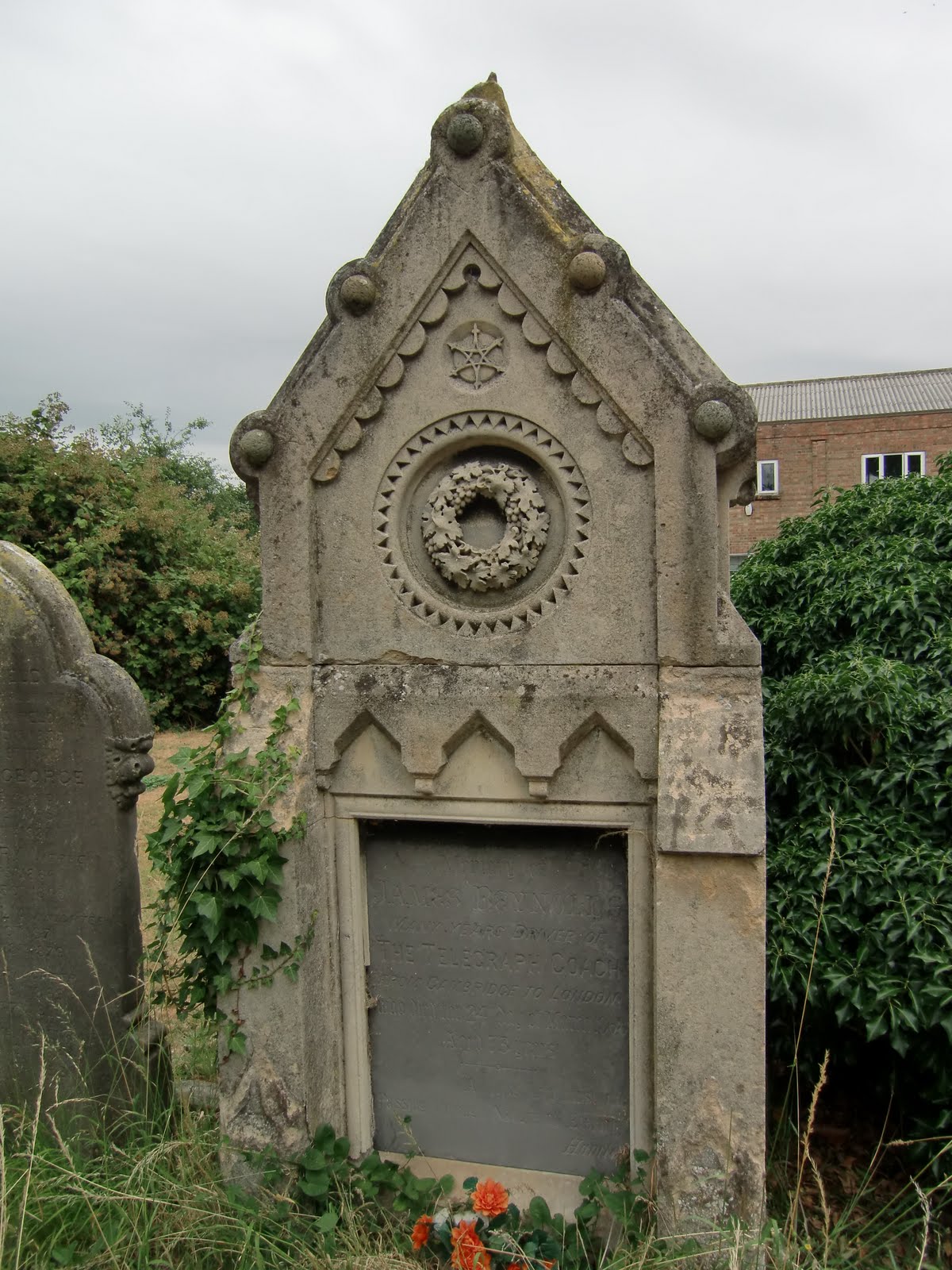
James Reynolds, Telegraph Stagecoach Driver

Mill Road, Cambridge

The Inscription reads:

‘Memory of James Reynolds
many years driver of the Telegraph Coach
from Cambridge to London
who died the 24th day of March 1868 aged 73 years
"All that live must die,
Passing through Nature to Eternity”. Hamlet’


In the early 1800s when the roads had improved beyond all recognition, travel eventually become ‘almost’ pleasurable. Coaches were able to attain speeds of up to 10 mph – cutting journey times by hours and in some cases days. What had been a two day journey from London to Cambridge (61 miles) in 1750, was possible in just six hours by 1836.

London predominated as the hub of all stagecoach services up until the 1750s, but within ten years, stagecoach services were operating between all major towns and cities and the number of provincial links had increased dramatically.
Local services were still served by carrier’s carts, generally operating between public houses, but the much larger inns, offering accommodation and fine food, were always the starting and terminating points for those travelling longer distances.

By the time the Cambridge Telegraph was in service in the early 1800's the coach left London daily at 9.00 in the morning (except Sunday) and arrived in Cambridge at the Sun Inn at 3.00 in the afternoon.
The return journey commenced in Cambridge at 1.00 in the morning and arrived at “9 the same morn”. By 1836 the time had been cut to 6 hours and one coach left Cambridge at 10.00 am daily whilst another left London at the same time to travel in the opposite direction.

Ideally there were four coaches called Cambridge Telegraph – two at each end, one in service, and the other in reserve. In late 1700's it cost £4 a month, including the wages of horse keepers and stable hands, to keep a coach horse on the road. The horses trotted and tried to keep a steady pace of ten miles an hour. Galloping could only be sustained for a short distance and was only indulged in to make up lost time.The lifespan of a horse on a stage coach route was only 3 to 4 years and they were then sold to farmers for lighter duties.

Due to the population’s desire to travel, stagecoach capacity was increased. The maximum number of six passengers ( carried in the 1740s ) was increased to eight or ten (inside and out) by the end of the century, and by 1810 coaches were large enough to carry up to eight people inside in ‘reasonable’ comfort, with eight more taking their places outside – open to the elements but at a much reduced fare.
There were accidents though, carrying so many people as well as their luggage, often led to stagecoaches tipping over on the more winding roads.


Journeys were also invariably long and tedious and frequent stops were made inns along the way. Tired horses would be changed for a fresh team and passengers were allowed 10–20 minutes for refreshments. For innkeepers the stagecoaches were a lucrative trade.
 Although the coaching era spanned 200 years, the real boom was between 1810 and 1830. During this time a nationwide network of services had been formed and some 3,000 coaches, and 150,000 horses both private and mail, were employed in the transportation of people.
Freight continued to be carried by the more efficient canal system until the 1830s but then went by rail, as did the mail from London. It was the arrival of the railways that put the final nail in the stagecoach coffin, for although they continued to be used in rural areas for some years to come, most people wanted to travel by rail.


Tuesday, 20 July 2010

Serpents and Snakes


Whilst visiting the cemetery in Haverhill, Suffolk yesterday, I was drawn to this monument that I assumed to be the Virgin Mary, even though there is no Sacred heart symbol or any of the other usual indicators as to her identity. However, when I took a closer look, I noticed that she was standing on a serpent with an apple in it's mouth.


In the Bible Genesis 3: 1-15: when Eve said that the serpent had beguiled her to eat the forbidden fruit, God told the serpent that it was cursed above all other animals, saying that it shall crawl upon its belly and eat dust all the days of its life and the Lord told the serpent that Eve and all her her offspring would crush the serpents head and that it would bite their heel.
So is this Mary or could it be Eve ?  and is this serpent a symbol of mortal temptation ?


This monument in the Histon Road Cemetry, Cambridge, has a snake on each of its four sides, each one in a different position. The first snake above is an Ouroboros ( a snake biting or eating it's own tail ) a symbol of immortality, rejuvenation and eternity.  


And lastly, this snake from Mill Road cemetery in Cambridge, holds the cloth which is draped around the urn.  


Friday, 16 July 2010

George Kett III, Grade II Listed Grave

George Robert Kett OBE was the grandson of the George Kett who co-founded the architectural wood and stone carvers Rattee & Kett, and the son of George Kett JP, three times mayor of Cambridge. 
George Robert married Elizabeth Coles of London in 1884, and they had three children, Catherine (b 1885), Hilda (b 1887) and George (b 1891). During World War I, George Robert ran the National Service Scheme and became Cambridge’s Executive Officer for Food Control. He was awarded an OBE for his services to the country.
 

The monument is a chest tomb, with a cruciform top. At one end, carved in high relief, is a kneeling figure of Mary Magdalene holding a jar. There is an inscription to Elizabeth, who died in 1913, and George Robert, who died in 1933. The tomb lies nearby his grandfathers monument. 


The inscription reads as :
‘Sacred to the memory of Elizabeth Evans Ann Mary beloved wife of George R Kett
Born at Islington Feb 9th 1860. Died at Cambridge Oct 16th 1913
and of George Robert Kett OBE
Born at Cambridge October 14th 1860
Died at Stapleford Cambridge July 1st 1933’


George Kett's Grade II Listed Grave

My previous post was about James Rattee and so this one is about George Kett his business partner whose tombs are side by side.


George Kett was born in Norfolk and was a skilled carpenter and wood carver. He moved to London with his wife Sarah and five children – George, Joanna, Edmund, and twins William and Alfred – to work on the interiors and furnishings of the new Palace of Westminster under architect and designer Augustus Pugin. Pugin was said to be so pleased with Kett’s finely detailed work that he chose him to carve the royal coat of arms in the Chamber of the House of Lords.

By 1848, Kett had moved to Cambridge to set up an architectural wood and stone carving business with James Rattee, whom he had met earlier in the late 1830’s whilst they were both employed in restoring Norwich Cathedral. Rattee was by now renowned locally as a highly skilled wood and stone craftsman. Their company was originally known as the Wood and Stone Carving Works, Cambridge, though its name was quickly changed to Rattee and Kett.
George and Sarah now had seven children, their new additions Susannah, born 1846 in London, and Frederick, born 1848 in Cambridge.
The company flourished, and Kett took over the responsibility of running it after the sudden death of James Rattee, at the age of 34, in 1855.
George Kett himself died in 1872, at the age of 63. His wife Sarah, who outlived him by 13 years, youngest son Frederick James who died in 1916, and youngest daughter Susannah Elizabeth, who died in 1941, are also buried in the tomb.

The headstone reads as:

George Kett born 26 June 1809 died 12 Aug 1872
and Sarah his wife born 22 April 1809 died 18 Nov 1885
“Passed from death into life” V John 24'
'Frederick James
Son of the above died Dec 16 1916
Aged 68 years'
'And Susannah Elizabeth
born May 26 1846 died August 16 1941’

The surround reads as:
'Look for the resurrection of the dead and the life of the world to come. Amen'


Wednesday, 14 July 2010

James Rattee's Grade II Listed Grave

Mill Road Cemetery in Cambridge is tucked away from view like a Secret forgotten Garden and can easily be overlooked. It's large size is surprising, considering it is accessible from two rather small unimpressive entrances, which give nothing away to the unknowing passerby. However the cemetery is in regular use, by dog walkers or those using the paths as a short cut through.
The Friends of Mill Road Cemetery host many community based activities for the entire family to join in, such a nature trails and creative fun days within the cemetery.
There are also some hidden Grade II listed graves, that are a treasure........

     
James Rattee was a highly skilled woodcarver and stonemason whose work can be seen in the chapels of Jesus and Magdalene Colleges and the Round Church in Cambridge, as well as in Ely Cathedral, Westminster Abbey and Eton College chapel.
 He was born in Norfolk in 1820, and was apprenticed to a Norwich carpenter, who also taught him carving. He showed an interest in church ornamentation and restoration and first met George Kett while the latter was working on the restoration of Norwich Cathedral in the 1830s.

Rattee moved to Cambridge in 1842, and set up business as a woodcarver. His reputation as a craftsman grew swiftly and his successes included the carving of the choir stalls in Ely Cathedral, hailed as ‘the most elaborate piece of art workmanship executed since the Reformation’.
To expand the business, he asked George Kett to join him as partner. Their company was originally called the Wood and Stone Carving Works, Cambridge, though its name was soon changed to Rattee & Kett. 
 Although dedicated to his work, Rattee's health was not good. In 1852, his doctor advised him to take a break and he travelled to the Continent. While there, he spent time studying with master carvers in Cologne, Hamburg and Antwerp. On his return, he constructed George Gilbert Scott’s design for the five-panelled reredos at Ely Cathedral. In 1855, he suddenly fell ill with a cold and, already weak, was unable to fight the infection. Forty-eight hours later, he died at his home in Hills Road.
He was buried in Mill Road Cemetery on the afternoon of Good Friday, 1855, with a huge crowd in attendance, who came to ‘evince their admiration of his abilities and respect for his character’.
He was only 34. His widow Caroline Rattee retained a share and interest in the business of Rattee & Kett until her death in 1866. She is also buried in the tomb, as is James Rattee’s mother.
The monument is Grade II listed as being of historical or architechtural importance

The left-hand panel reads:

‘Erected to the memory of
James Rattee who departed this life
the 29th of March 1855 aged 34 years.
“He is not dead, but sleepeth”
Also of Caroline Louis (widow of the above)
who died 9 March 1866
aged 45 years’
(remainder illegible)

The right-hand panel reads:

‘In the same vault
lies the body of Elizabeth
(mother of James Rattee)
who died the 13th of Dec 1850
aged 64 years.
Also of Charlotte Berridge
who died the 14th March 1853
aged 29 years.
“Death where is thy sting”
Also of …’
(remainder illegible)


Related Posts Plugin for WordPress, Blogger...