A Member of The Association of Graveyard Rabbits

Pages

Showing posts with label Folk Lore. Show all posts

Friday, 15 April 2011

Friday's Funerary Symbols ~ The Anvil


Verdriet en Geluk Lopen Samen
( Sorrow and Happiness Travel Together )
Chris Kotterer
13~02~1918     19~12~1997

Traditionally the Anvil symbolises the essential forging of the Universe and the one pictured above has an Anchor etched on it, which symbolises hope.

Saint Clement ~ who features in the Legend below ~ was the patron saint of Blacksmiths 
He was a Roman bishop, who died in 100AD.
He was martyred after having been bound to an anchor and thrown into the Black sea on November 23 of that year.


Legend of The Blacksmiths Anvil

People of the Ancients worlds regarded Blacksmiths as being endowed with supernatural skill, and therefore they were thought of as magicians, with divine powers. Because they worked with the elements of fire and air, they were able to turn rock ore into metals that made tools for farming, domestic implements and weapons for protection. This exclusive knowledge of metal-working was an art shrouded in mystery.
Throughout worldwide mythologies, blacksmiths were magical craftsmen who were looked upon as superior to other artisans, owing to their faculty of working with fire and of manipulating iron with ease and dexterity. It was believed that their wondorous abilities were above the plane of ordinary mortals, surely because they had received supernatural instruction. .
The importance of the blacksmith's art in early mediaeval times is told in the following tale.

King Alfred the Great ~ 849~899AD ~ assembled together seven of his main craftsmen, to appoint one of them as the Chief above the others. It would be awarded to the one whose craft could sustain the longest, without the assistance of the others.
Alfred invited them all to a banquet,  and commanded them to bring a specimen of their handiwork and the tools with which it was made. 
The blacksmith brought his hammer and a newly forged horse-shoe, the tailor his scissors and a newly sewn garment.
The baker brought his wooden bread-shovel and a loaf of freshly baked bread, the shoemaker brought his awl and a pair of newly stitched shoes.
The carpenter brought his saw and a squared plank, the butcher brought his boning-knife and a large piece of meat and the mason brought his trowel and a corner-stone.

After careful consideration, a decree was made that the tailor's work made him the best choice and so he was chosen to be the Chief of the artisans.
The blacksmith felt aggrieved and vowed to work no more, for as long as the tailor was chief, so he closed his forge and left.

Soon after, the King's horse lost a shoe and the remaining craftsmen, one after another wore down their tools. Although the tailor continued to ply his trade longer than the others, he too was soon obliged to cease work.
Whereupon the King and his artisans decided to try their hands at blacksmithing.
The King's horse trod on his royal master, the tailor burnt his fingers whilst the others met with various mishaps.

They began to quarrel among themselves and in the fracas, the anvil was overturned with a crash. Saint Clement appeared, arm in arm with the blacksmith and the King welcomed them respectfully, saying:
"I have made a bad mistake, my friends, in allowing myself to be beguiled by the tailor's fine cloth and his skillful handiwork; in common fairness the blacksmith, without whose aid the other workmen can accomplish nothing, should be proclaimed chief artisan."
The tradesmen, with the exception of the tailor, begged the worthy Blacksmith to make new tools for them, which he proceeded to do, including a brand-new pair of scissors for the tailor.
Then the King reorganized the society of artisans and proclaimed the Smithy as Chief, who was greeted with wishes for good health and happiness.
As celebrations began, a song entitled 'The Merry Blacksmith' was sung and can still be heard to this day at the festivities of tradesmen's guilds in England.

Saint Eligius ( Eloy ), is also represented as the guardian of farriers and blacksmiths. He flourished in the seventh century, and in his youth served as an apprentice to a goldsmith at Limoges, where he became very proficient in the art of working the precious metals.
According to a well-known legend, Saint Eligius was shoeing a horse, which refused to stand still, he is said to have cut off the animal's foot, to put on the shoe. After making the sign of the cross, he replaced the foot and the horse experienced no harm or ill effects.

Saturday, 12 March 2011

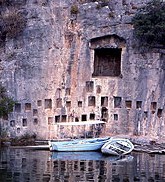
Rock Tombs ~ Dalyan, Turkey


A few years ago we visited Dalyan, a small traditional Turkish fishing village which nestles on the river near Lake Köycegiz on the south west corner of Turkey's Mediterranean coast.
The area is famous for the Loggerhead turtles that nest on it beaches, the natural mud baths on the banks of it's river and some of the best examples of ancient Lycian Rock Tombs which were carved out of the local cliffs 2,500 years ago.
These tombs are the resting place of the Kings of Caunos and date back to 400BC.

Click on the bold italic text for more information.


The most important tombs were cut into the rock face with the facade of a temple, with it's pediment and columns. The tombs consist of a stepped front chamber behind the facade and the burial chamber is accessed through a door.
Inside the roughly square burial chamber, there are carved stone benches for the bodies of the deceased and in some of them, there are also tables for offerings dedicated to the deceased.
The niches, into which the upright funerary urns were placed, were closed with stone plaques that were carved with depictions of temple facades. The tombs were covered with large stone slabs which were coated by a thick plaster mixed with gravel.


In addition to the temple rock-cut tomb, there are deep rectangular rock tombs known as 'pigeon nests', consisting of niches and sarcophagi, which together with the chamber tombs, show the variety of the types of funerary architecture at Caunos ( Kaunus ) ~ The Lycian settlement at Dalyan.


At night the rock tombs are illuminated, and so one evening we sat by the waters edge in a homely rustic restaurant and enjoyed the view across the river from them.  

The Legend of Caunos

Miletus, the son of Apollo, had twins, a son named Caunos, and a daughter named Byblis. When the twins became adults, Byblis fell in love with Caunos. And so she wrote him a letter declaring her incestuous love for him. This enraged Caunos and all he could feel in return, was a sense of loathing toward her. Because of this, Caunos decided to leave for the region of Karia with his followers, where he built a city that he named after himself. Byblis was heart-broken and wanted to commit suicide, so she jumped from the highest rocks. Nymphs took pity on her and turned her to a spring. As Byblis's tears flowed, they formed the river.

Biblis by William Adolphe Bouguereau 1884

Dalyan River and Lake Köycegiz


Monday, 31 January 2011

Monday Mourning ~ Deadly Supersitious

Deadly Supersitious

In every culture around the world there are supersitious signs and omens surrounding death and dying and the foretelling of this event. Some you may have already heard of before and others are a variation of a theme........
Here are just a few: 

If the deceased has lived a good life, flowers would bloom on their grave; but if they have been bad, only weeds will grow upon it.


If several deaths occur in the same family, tying a black ribbon to everything left alive that enters the house, even animals, will protect against more deaths spreading further.

Bad Luck will follow you if you wear anything new to a funeral, especially shoes.

Always cover your mouth while yawning so your spirit doesn’t escape and the devil could enter your body instead.

It is bad luck to meet a funeral procession head on. If you see one approching, turn around. If this is unavoidable, hold on to your collar until the funeral cortege passes.

Large drops of rain warn that there has just been a death.

Stop the clock in a death room or you will have bad luck.

To lock the door of your home after a funeral procession has left the house is bad luck.

If rain falls on a funeral procession, the deceased will go to heaven.

If you hear a clap of thunder following a burial it indicates that the soul of the departed has reached heaven.

If you hear 3 knocks and no one is there, it usually means someone close to you has died. The superstitious call this the 3 knocks of death.

If you leave something that belongs to you to the deceased, that means the person will come back to get you.

If a wild bird enters your house it is a portent of someone living there, dying soon.


If you smell roses or lillies when none are present, someone is going to die.

If you don’t hold your breath while going by a graveyard you will not be buried.

If you see yourself in a dream, your death will follow.

If you see an owl in the daytime, a death will follow.

If you dream about a birth, someone you know will die.

If it rains in an open grave then someone in the family will die within the year.

If a picture falls off the wall, there will be a death of someone you know.


If you spill salt, throw a pinch of the spilt salt over your shoulder to prevent a death from happening in the family.

Never speak ill of the dead because they will come back to haunt you or you will suffer misfortune.

Two deaths in the family means that a third is sure to follow.

The cry of a curlew or the hoot of an owl foretells a death.

A single snowdrop growing in the garden foretells a death.

Having only red and white flowers together in a vase (especially in hospital) means a death will soon follow.

Dropping an umbrella on the floor or opening one in the house means that there will be a death in the house.

A diamond-shaped fold in clean linen portends death.

A dog howling at night when someone in the house is sick is a bad omen. It can be reversed by reaching under the bed and turning over a shoe.


Sunday, 31 October 2010

Day of the Dead

From October 31st to November 2nd, the people of Mexico celebrate el Día de los Muertos - the Day of the Dead! The festival is a traditional and beautiful celebration of the lives of those who have passed on and allows the living to remember them in their own way. The festival encompasses bright costumes, dancing skeletons, candy skulls, showers of marigolds and the odd indulgence in a tequila or two.

So sit back and enjoy the music and the show.


Related Posts Plugin for WordPress, Blogger...