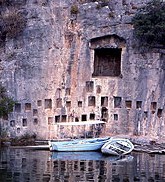
A few years ago we visited Dalyan, a small traditional Turkish fishing village which nestles on the river near Lake Köycegiz on the south west corner of Turkey's Mediterranean coast.
The area is famous for the Loggerhead turtles that nest on it beaches, the natural mud baths on the banks of it's river and some of the best examples of ancient Lycian Rock Tombs which were carved out of the local cliffs 2,500 years ago.
These tombs are the resting place of the Kings of Caunos and date back to 400BC.
Click on the bold italic text for more information.
The most important tombs were cut into the rock face with the facade of a temple, with it's pediment and columns. The tombs consist of a stepped front chamber behind the facade and the burial chamber is accessed through a door.
Inside the roughly square burial chamber, there are carved stone benches for the bodies of the deceased and in some of them, there are also tables for offerings dedicated to the deceased.
The niches, into which the upright funerary urns were placed, were closed with stone plaques that were carved with depictions of temple facades. The tombs were covered with large stone slabs which were coated by a thick plaster mixed with gravel.
In addition to the temple rock-cut tomb, there are deep rectangular rock tombs known as 'pigeon nests', consisting of niches and sarcophagi, which together with the chamber tombs, show the variety of the types of funerary architecture at Caunos ( Kaunus ) ~ The Lycian settlement at Dalyan.
At night the rock tombs are illuminated, and so one evening we sat by the waters edge in a homely rustic restaurant and enjoyed the view across the river from them.
The Legend of Caunos
Miletus, the son of Apollo, had twins, a son named Caunos, and a daughter named Byblis. When the twins became adults, Byblis fell in love with Caunos. And so she wrote him a letter declaring her incestuous love for him. This enraged Caunos and all he could feel in return, was a sense of loathing toward her. Because of this, Caunos decided to leave for the region of Karia with his followers, where he built a city that he named after himself. Byblis was heart-broken and wanted to commit suicide, so she jumped from the highest rocks. Nymphs took pity on her and turned her to a spring. As Byblis's tears flowed, they formed the river.
Biblis by William Adolphe Bouguereau 1884
Dalyan River and Lake Köycegiz