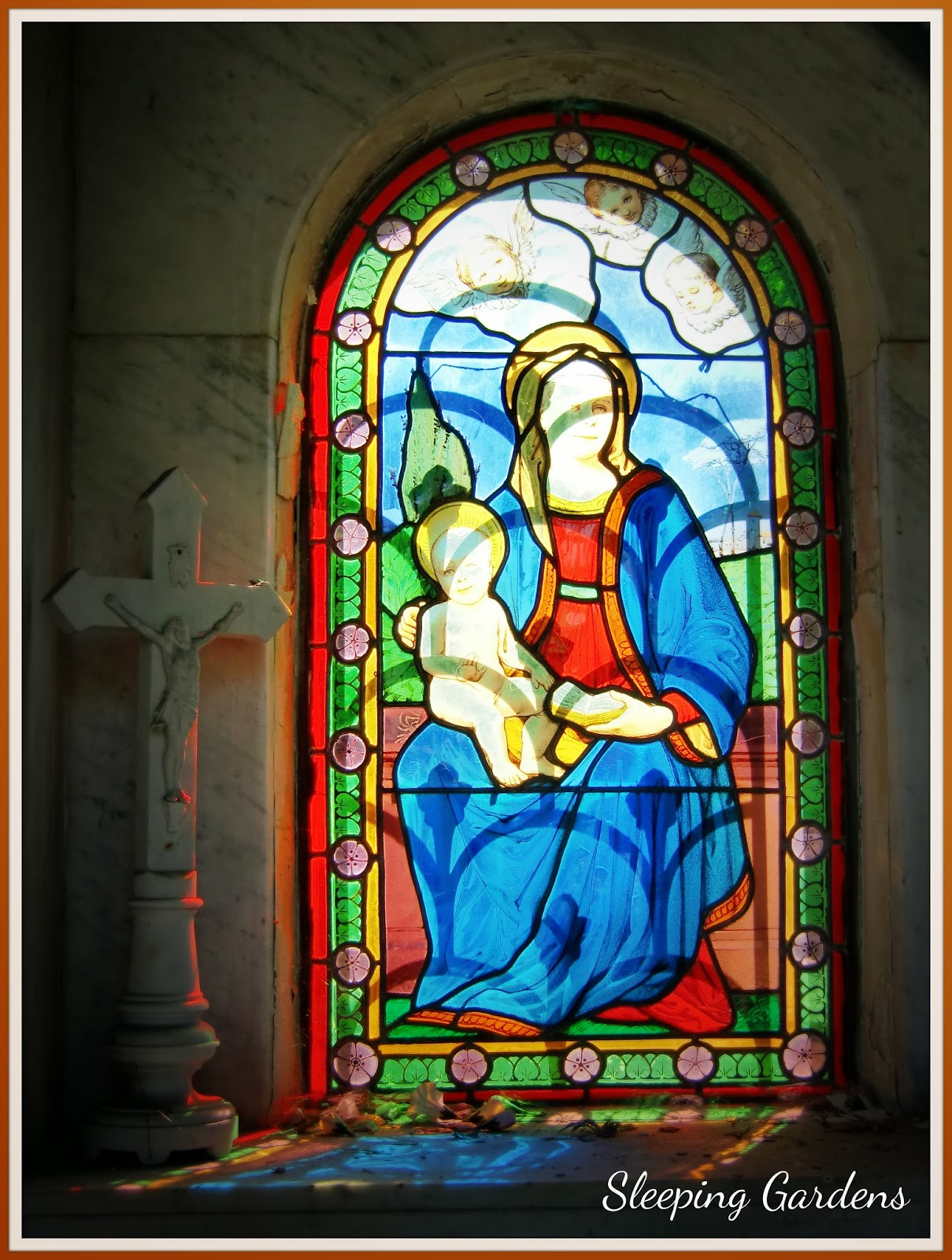
Very often the delicate stained glass windows in mausoleums are damaged or missing altogether, this may be due to the elements, vandals or just the ravages of time. So it was a joy to find many of these works of art in tact and still looking beautiful more than a century later in the Cemeteries of Paris. Here are a selection of those to be found in Montmatre.
Showing posts with label Mausoleum. Show all posts
Monday, 18 November 2013
Wednesday, 4 September 2013
Perfumer of Edinburgh
William Raeburn 1785
To Memory
of William Raeburn
Perfumer Edinburgh,
who died 24th March 1812
Aged 60 Years
Erected
James Raeburn
Perfumer Edinburgh
On a recent trip to Scotland we visited the Old Calton Burial Ground in Edinburgh, Scotland. In 1718 it became a place of interment for the local artisans and tradesmen of the Burgh of Calton, but later became popular and many eminent literary, scientific and artistic figures were also buried here.
Although it is well cared for and tended now, it must have fallen into decline over the years as most of the mausoleums are now simply shells of their former glory.
Labels:
Edinburgh,
Mausoleum,
Old Calton Burial Ground,
Perfumer,
Scotland
Monday, 27 May 2013
Monday Mourning ~ Mausoleum Meltdown
Roughly translated this notice announces:
Not withstanding the ravages of time, this Sepulchre has deteriorated. Which appears to be left abandoned. A procedure of reprise is engaged. If you wish to preserve it, please present the Town Hall for action to be taken.
I sure hope that someone does present a petition to save this mausoleum.
Labels:
Cahors,
France,
Lot,
Mausoleum,
Monday Mourning
Friday, 24 May 2013
Friday's Funerary Symbols ~ Grim Reaper Scythes
The Scythes on this mausoleum in the village of Saint~Cirq~Lapopie, represents the cuttting of mortal ties with the land of the living, as the Souls of the recently deceased are harvested by the Grim Reaper.
Inside the mausoleum
The beautifully detailed Winged Hourglass on the lower half of the door depicts the swift passage of time.
Here's another pair of Scythes, this time from Cahors Cemetery, France.
Labels:
Cahors,
France,
Friday's Funerary Symbols,
Grim Reaper,
Hourglass,
Lot,
Mausoleum,
Saint~Cirq~Lapopie,
Symbols
Sunday, 19 May 2013
Wednesday, 25 July 2012
Pyramid of Death
Listed amongst the Landmark buildings that 'Never Were', you would find London's Pyramid of Death.
In 1829, architect Thomas
Willson planned a pyramid mausoleum to be located in Primrose Hill, North London. It would hold up to five million bodies because of the lack of burial space in the capital's churchyards.
'It was supposed to be compact, hygienic and ornamental,' says Catharine Arnold, an expert on London's dead.
'Willson hoped people would come to admire this huge pyramid from far and wide, picnicking on Primrose Hill and enjoying this splendid monument. But it would be rather like a giant car-park of the dead,' says Arnold.
The pyramid-design caught the public's mood for Egyptiana - the height of fashion at the time. Winding walks, similar to today's Guggenheim Museum in New York, were planned to transport the bodies through the pyramid's catacombs to their final resting places.
Why didn't it happen?
'It would have been monumental, but grotesque - a literal Valhalla,' says author Simon Jenkins.
'Public opinion stopped it. The arguments for leaving the site wild won the day and Primrose Hill became one of London's most popular parks.'
Willson claimed the pyramid would cost £2,500 on completion and would make £10m profit when
full, but there was suspicion among the authorities that his figures did not add
up.
There was also concern that the weight of the bricks may have crushed
Primrose Hill. And the public mood turned against necropolises - cities of the
dead - as garden-style cemeteries became the norm.With the building of Highgate cemetery in 1829, the pyramid scheme was finally shelved.
Thanks to BBC News for this information.
Monday, 18 April 2011
Monday Morning's ~ Mausoleum
The Ongley Family purchased the Old Warden Estate in 1700 from the Bolingbroke Family. They owned Old Warden Park until 1872 when it was sold to Joseph Shuttleworth. This family's mausoleum was built in 1790 with space for 42, however from 1790 to 1877, only 10 were interred here. Family memorials are in St. Leonards Church.
This monument rests on the plinth with dedication shown below
Near this place is desposited the remains of
Sr. Samuel Ongley Kt.
Who by his indefatigable Industy acquir'd a very plentifull Estate,
was charitable to the Poor, and very bountifull
to his Relations, was free from Pride and Ostentation,
always easy of Access, a kind Neighbour, a sincere Friend
and delighted in doing good offices to all Mankind.
he was formerly a director of the East India and the first
Deputy Govenour of the South Sea Companys, and at his
death being Govenour to three Hospitals, was a Liberall
Benefactor to each: he serv'd his Country impartially as
member of Parliment for Maidstone in the County of Kent
(his native place) Who for his good Services received the
Honour of Knighthood.
He departed this life the 25th day of August 1726
in the 80th year of his Age
Labels:
Bedfordshire,
Churchyards,
Mausoleum,
Monday Mourning
Monday, 4 April 2011
Monday Mourning's Mausoleum
There were only a few headstones remaining in the Churchyard of St. Nicholas's Church, Loughton, Essex. But there was also this beautiful little Gothic Mausoleum, belonging to Mary French.
Here rests
the body of
MARY
wife of
Jos. FRENCH of
Little Burstead
in this County Est.
? Feb. 11th 1860
? 77
I did take a peek into the window at the back, but there were only a few old LP album covers from the '60's in there and nothing else, so it looks as though someone had sadly used it as a litter bin.
Labels:
Churchyards,
Essex,
Mausoleum,
Monday Mourning
Tuesday, 23 November 2010
Circus Director's Masoleum
The masoleum of Circus Director Oscar Carré 1846-1911, was designed in the neo-classical style by Ross and Vuyk in 1891. It was built for his first wife Amalia Salamonski who died in May 1891. Oscar himself died in 1911 on a tour through Denmark in Copenhagen. But because the masouleum was not prepared for him, his body was buried for a year in the Great Church of Copenhagen before arriving in it's final resting place inside the masoleum.
The floors and walls of the interior have decorative motifs and a marble bust of Amalia Salamonski, by Henri J. Teixeira de Mattos.
The Butterflies that adorn the tops of the Columns, represent Resurrection.
Oscar Carre and Edith Maud Adams-Carre
Subscribe to:
Posts (Atom)