

A Member of The Association of Graveyard Rabbits
Wednesday, 28 July 2010

Friday, 23 July 2010


Thursday, 22 July 2010
James Reynolds, Telegraph Stagecoach Driver
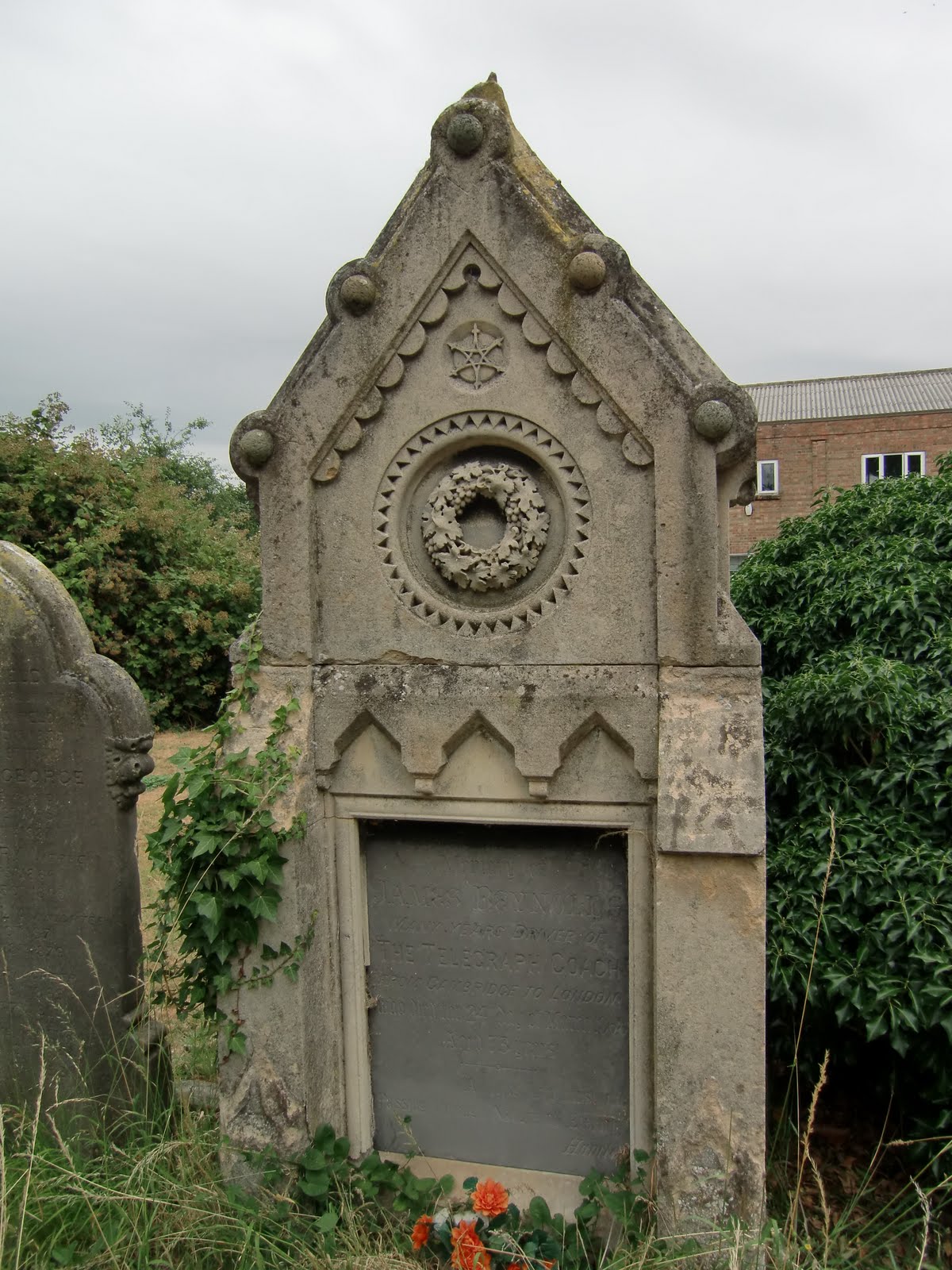
Mill Road, Cambridge
The Inscription reads:
‘Memory of James Reynolds
many years driver of the Telegraph Coach
from Cambridge to London
who died the 24th day of March 1868 aged 73 years
"All that live must die,
Passing through Nature to Eternity”. Hamlet’

In the early 1800s when the roads had improved beyond all recognition, travel eventually become ‘almost’ pleasurable. Coaches were able to attain speeds of up to 10 mph – cutting journey times by hours and in some cases days. What had been a two day journey from London to Cambridge (61 miles) in 1750, was possible in just six hours by 1836.
London predominated as the hub of all stagecoach services up until the 1750s, but within ten years, stagecoach services were operating between all major towns and cities and the number of provincial links had increased dramatically.
Local services were still served by carrier’s carts, generally operating between public houses, but the much larger inns, offering accommodation and fine food, were always the starting and terminating points for those travelling longer distances.
By the time the Cambridge Telegraph was in service in the early 1800's the coach left London daily at 9.00 in the morning (except Sunday) and arrived in Cambridge at the Sun Inn at 3.00 in the afternoon.
The return journey commenced in Cambridge at 1.00 in the morning and arrived at “9 the same morn”. By 1836 the time had been cut to 6 hours and one coach left Cambridge at 10.00 am daily whilst another left London at the same time to travel in the opposite direction.
Ideally there were four coaches called Cambridge Telegraph – two at each end, one in service, and the other in reserve. In late 1700's it cost £4 a month, including the wages of horse keepers and stable hands, to keep a coach horse on the road. The horses trotted and tried to keep a steady pace of ten miles an hour. Galloping could only be sustained for a short distance and was only indulged in to make up lost time.The lifespan of a horse on a stage coach route was only 3 to 4 years and they were then sold to farmers for lighter duties.
Due to the population’s desire to travel, stagecoach capacity was increased. The maximum number of six passengers ( carried in the 1740s ) was increased to eight or ten (inside and out) by the end of the century, and by 1810 coaches were large enough to carry up to eight people inside in ‘reasonable’ comfort, with eight more taking their places outside – open to the elements but at a much reduced fare.
There were accidents though, carrying so many people as well as their luggage, often led to stagecoaches tipping over on the more winding roads.

Journeys were also invariably long and tedious and frequent stops were made inns along the way. Tired horses would be changed for a fresh team and passengers were allowed 10–20 minutes for refreshments. For innkeepers the stagecoaches were a lucrative trade.
Although the coaching era spanned 200 years, the real boom was between 1810 and 1830. During this time a nationwide network of services had been formed and some 3,000 coaches, and 150,000 horses both private and mail, were employed in the transportation of people.
Freight continued to be carried by the more efficient canal system until the 1830s but then went by rail, as did the mail from London. It was the arrival of the railways that put the final nail in the stagecoach coffin, for although they continued to be used in rural areas for some years to come, most people wanted to travel by rail.
Tuesday, 20 July 2010
Serpents and Snakes

Whilst visiting the cemetery in Haverhill, Suffolk yesterday, I was drawn to this monument that I assumed to be the Virgin Mary, even though there is no Sacred heart symbol or any of the other usual indicators as to her identity. However, when I took a closer look, I noticed that she was standing on a serpent with an apple in it's mouth.


In the Bible Genesis 3: 1-15: when Eve said that the serpent had beguiled her to eat the forbidden fruit, God told the serpent that it was cursed above all other animals, saying that it shall crawl upon its belly and eat dust all the days of its life and the Lord told the serpent that Eve and all her her offspring would crush the serpents head and that it would bite their heel.
So is this Mary or could it be Eve ? and is this serpent a symbol of mortal temptation ?

This monument in the Histon Road Cemetry, Cambridge, has a snake on each of its four sides, each one in a different position. The first snake above is an Ouroboros ( a snake biting or eating it's own tail ) a symbol of immortality, rejuvenation and eternity.


And lastly, this snake from Mill Road cemetery in Cambridge, holds the cloth which is draped around the urn.

Sunday, 18 July 2010
Sleeping Gardens

Walking through the Sleeping gardens
Stepping soft amongst the stones
Names and dates all carved in marble
Resting beneath them, only bones
Lilies scented, sweet and heady
Waxen petals, pure and white
Remind me of, when I last saw you ~
Had slipped away by candlelight
I had brushed your hair so golden
Kissed your lips so pale and cold
Told you that my heart was broken
You’d stay young as I grew old
Walking through the Sleeping gardens
Tears roll down my grieving cheek
Softly whispering I love you
No more words I’ll hear you speak
So I must wait until you meet me
On the other side of life
Reunited and immortal
Shedding off this mortal strife


Friday, 16 July 2010
Reclining Ladies
Some are resting and some are weeping

Chelmsford, Essex

San Michele, Venice, Italy

Montparnasse, Paris
George Kett III, Grade II Listed Grave
George Robert Kett OBE was the grandson of the George Kett who co-founded the architectural wood and stone carvers Rattee & Kett, and the son of George Kett JP, three times mayor of Cambridge.
George Robert married Elizabeth Coles of London in 1884, and they had three children, Catherine (b 1885), Hilda (b 1887) and George (b 1891). During World War I, George Robert ran the National Service Scheme and became Cambridge’s Executive Officer for Food Control. He was awarded an OBE for his services to the country.

The monument is a chest tomb, with a cruciform top. At one end, carved in high relief, is a kneeling figure of Mary Magdalene holding a jar. There is an inscription to Elizabeth, who died in 1913, and George Robert, who died in 1933. The tomb lies nearby his grandfathers monument.

George Robert married Elizabeth Coles of London in 1884, and they had three children, Catherine (b 1885), Hilda (b 1887) and George (b 1891). During World War I, George Robert ran the National Service Scheme and became Cambridge’s Executive Officer for Food Control. He was awarded an OBE for his services to the country.

The monument is a chest tomb, with a cruciform top. At one end, carved in high relief, is a kneeling figure of Mary Magdalene holding a jar. There is an inscription to Elizabeth, who died in 1913, and George Robert, who died in 1933. The tomb lies nearby his grandfathers monument.

The inscription reads as :
‘Sacred to the memory of Elizabeth Evans Ann Mary beloved wife of George R Kett
Born at Islington Feb 9th 1860. Died at Cambridge Oct 16th 1913
and of George Robert Kett OBE
Born at Cambridge October 14th 1860
Died at Stapleford Cambridge July 1st 1933’
Subscribe to:
Posts (Atom)
