A Member of The Association of Graveyard Rabbits

Pages

Saturday, 24 September 2011

I Thought I Recognised This

Brompton Cemetery, London

Sacred
to the Memory of
General
Sir John Lysaght Pennefather
GCB
The Governor of The Royal Hospital Chelsea
Died 9th May 1872
In the 73rd Year of His Age
~ Verse ~
Also of Margaret, widow of the above
who entered into rest 7th February 1880
~ Verse ~
Also of Harriet Worrell ( Harrie )
The dearly loved wife of the Rev. Henry Pelham Stokes.M
Rector of Wareham Dorset: A Grand~daughter of the above
who fell asleep in Jesus 13th January 1882  


General Sir John Lysaght Pennefather GCB* B.9 September 1798 ~ D. 9 May 1872, was a British soldier who won two very remarkable victories. Firstly, at Meanee, India, where it was said that 500 Irishmen defeated 35,000 Indians.
Secondly, at the Battle of Inkerman, 5 November 1854 during the Crimean War, where he commanded a division of 3,000 Irishmen fighting in the fog were said to have defeated 35,000 Russians.
*Knight Grand Cross of the Order of the Bath

Information from Wikipedia  

As soon as I saw the monument above, I recognised it as being veri similar to the one below from Histon Road Cemetery, Cambridge..... 

Histon Road Cemetery, Cambridge

I have shown this particular monument in an earlier posting and have always admired it because of the beautiful fine detailed Weeping Willow branches that are draped over it. 
I also liked the fact that it appeared to be an original design as I had never seen another quite like it, that is until I discovered that of Gen. Sir John Lysaght Pennefather in Brompton Cemetery. 


Friday, 23 September 2011

Friday's Funerary Art ~ Stained Glass


W.L.Philippus
Wil
30~9~1917     25~11~2001


The decorated panel is made of Stained Glass in the religious Icon style.

click on the bold italic type for more information 


Wednesday, 21 September 2011

Wednesday's Child


Sacred
to the Memory
of Our Little
Tom
who died Jan. 10th 1882
Aged 2 Yrs 10 Months


The good condition of Little Tom's wooden head and footboard, lead me to think that they are not the originals. Tom has no surname that is visible, so who replaced them and when ?


Tuesday, 20 September 2011

Callosa d'En Sarria Cemetery, Valencia, Spain

We have just returned from a recent holiday to Valencia in Spain and I was rather interested in seeing some Spanish cemeteries whilst there, however locationing them proved to be more difficult as they seemed to be rather elusive.
Even in the larger towns, the usual signs for the 'Municipal Cementeri' were noticably absent.
So it was with a sense of delight, that we accidentally discovered the cemetery of Callosa d'En Sarria whilst visiting some local waterfalls. On a small quiet road, well outside the town, we spotted the cemetery by chance as we waited at the crossroads.  


The tall white walls that surround the Cemetery, do not allow passers by to see what is beyond them, even the gates above, can only be seen from outside when they are locked. It's only a small sign on the wall above that gives any indication as to what this place may be.


Imagine our surprise to find this beautifully tended oasis of peaceful greenery, on such a hot and dusty day.


A few mausoleums lined the main avenue of cypress trees that led from the gates and apart from a few graves dotted about on the lawns, the majority of tombs are wall vaults that stand 3 or 4 high.


As the cemetery expands, new areas have been built to accomodate future interments.


Spain is traditionally a Catholic country, so many of the carvings on the memorials are of a devoutly religious nature.


However one or two of the more modern ones did show the interests of those they were dedicated to. I shall include them in future posts.


Sunday, 18 September 2011

His Sister is Missing


This is the poster that hangs on the wall of the South Lodge in Brompton Cemetery, showing the graveside where the children originally stood.
Unfortunately the pair were stolen some 10 years ago, however the little boy turned up for sale in an auction, where he was recognised and returned to Brompton. He now resides in the South Lodge for safe keeping, sadly his sister has never been recovered.


If you've seen her and know of her whereabouts, please contact Brompton Cemetery, London, UK tel: 020 7352 1201. As her brother is missing her.........  


Tuesday, 6 September 2011

Ceramic Flowers


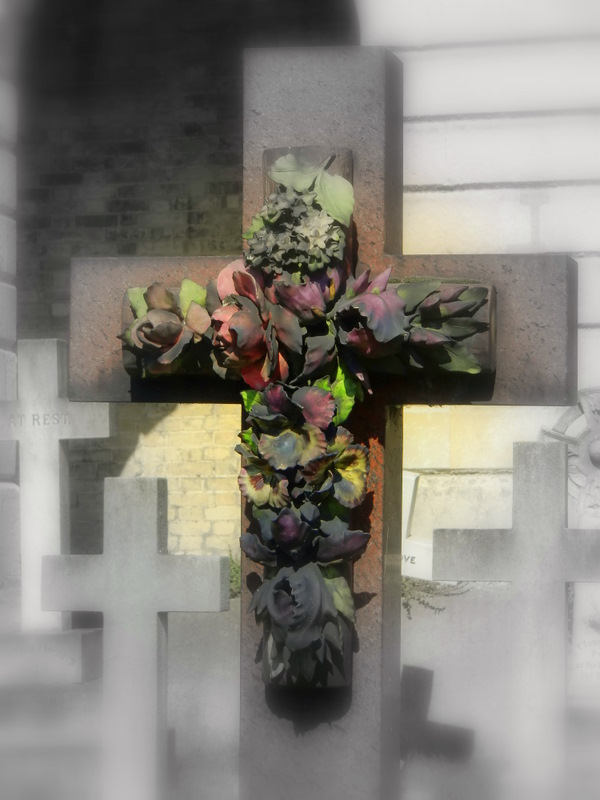
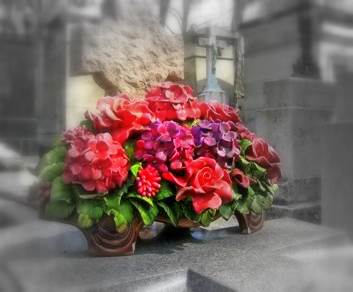
The ceramic flowers above come from various cemeteries in England, Wales and the Netherlands. They were particularly popular during Victorian times, providing an eternal floral tribute that ensured the graveside constantly appeared well tended, unlike fresh flowers that ultimately wither and die and would indicate how regularly the site was visited. 

The flowers themselves are made from sandstone and then brightly glazed in the Majolica style, it was a very popular pottery of it's time, and included a variety of decorative household items, from tableware to jardinieres and ornamental pieces.

It seems that France is now the main producer of these ceramic flowers, where there are many fine examples throughout the country's cemeteries. They are still exported worldwide today, with Australia importing them as they favour the European burial style.
Here are a few grand examples of ceramic flowers found at Pere Lachaise and Pons in France.


Monday, 5 September 2011

Monday Mourning ~ Tomb Styles

Temple Tombs

Brompton Cemetery

Temple Tombs have a low pitched roof that is supported on columns as shown above or with a similar roof supported by pillars at the front and with a solid wall at the rear, resembling a porticoed facade in the style of a Grecian Temple.


The Greek Revival style was a popular architectural movement of the late 18th and early 19th centuries, predominantly in Northern Europe and the United States.


Related Posts Plugin for WordPress, Blogger...