A Member of The Association of Graveyard Rabbits

Pages

Wednesday, 30 March 2011

Wednesday's Child


This little angel baby was discovered sleeping peacefully in the childrens section
of Leiston Cemetery, Suffolk, on the eve of Valentine's Day.


Tuesday, 29 March 2011

Man's Best Friend


SNOOKS
This memorial was erected
by the people of this borough
to Dr "Robin" PM Acheson
who cared for them 
from 1931 to 1959
and to Dr Nora
his wife
who died 1981
whilst still caring


Whilst walking along the seafront in Aldeburgh, Suffolk, we met Snooks, the beloved pet dog of Doctors Robin and Nora Acheson.
However, this is not the original 'Snooks', unfortunately he was stolen from his plinth in 2003. But he was obviously loved by more than just his owners, as the town had another one made to replace it.

This picture was taken in Februaury and as we have had a particularly cold winter this year, someone had kindly knitted poor Snooks a scarf which was wrapped around his neck. So before I could take this photograph, I had to remove it, and it goes without saying, that I securely replaced it when I was done.


Sunday, 27 March 2011

Monumental


Hier Rust
Arouwe Johanna Elisabeth Sophia Knoll
Eerder Weduwe Van Den Weled: Gest Heer
Adolph Fortgens Otter
Stichtster Der Elisabeth Otter Knoll Stichtingen
Geb: Te Utrecht 13 January 1820
Overl: Te Amsterdam 20 February 1900


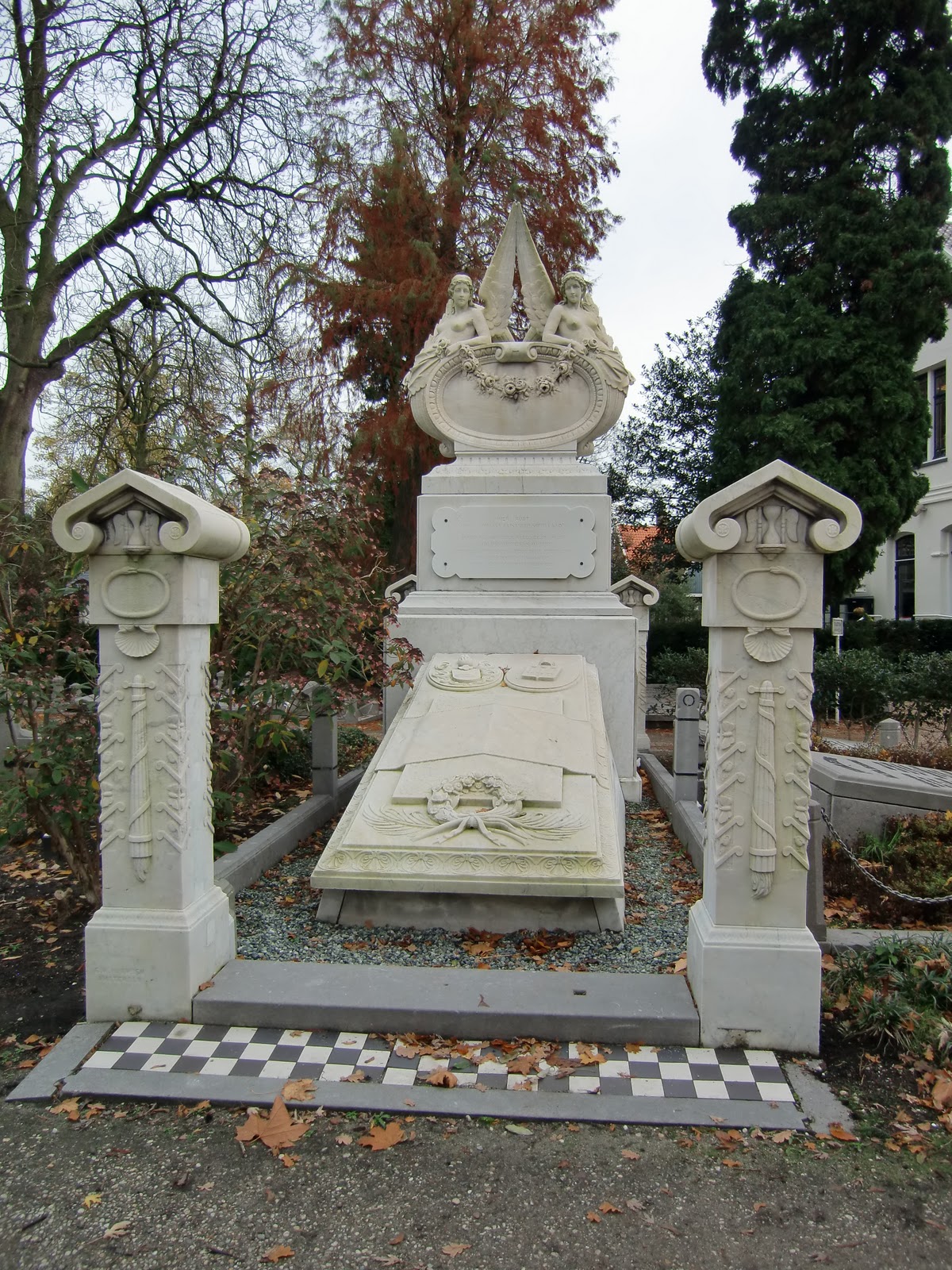
The grave of Johanna Sophia Elisabeth Otter-Knoll Cemetery on Zorgvlied is a national monument, designed by the sculptor GW Harmsen.


Elisabeth was raised by her maternal grandparents in Utrecht ~ her Father being a Captain in the Army. In 1847 Elisabeth married Adolph Fortgens Otter, a wealthy business broker ~ Stock, Port, Shipbuilding ~ and she went to with him to live in Amsterdam. When Adolph died in 1858, Elisabeth inherited half of his fortune and within a few years, other relatives died, also leaving their legacies to Elisabeth, who became a very wealthy woman indeed.


Three years after the death of Adolph, Elizabeth married Reverend Henry Luëssen ~ a contractual marriage ~ with whom travelled widely. In 1887 she was widowed for the second time.
Adolph had indicated in his will, that he wanted a portion of its assets to establish a foundation and home for elderly seamen of the merchant marine and navy in Amsterdam. But from 1860, the numbers of seaman requiring care was reduced and the plan was temporarily suspended.


In 1886, one year before the death of her second husband, Elizabeth made her own will. She stated that her very large house would be converted into a residence for 'Poor and Indigent old sea Captains and Mates', as desired by her first husband. She did everything in detail, from how the interior of the house should look and at what times the seaman would be served their meals. Also that the visiting of ladies, would be by permission only.  

In 1900, shortly before her death, Elisabeth also decided to establish a Foundation for Women from the Gentry. She said 'It is my desire to create a foundation for decent ladies that are insolvent and unable without fault in her own living. With regret, I saw ever how many times the decent good women in old age, if not much in want, still many were lacking, their old days should be quiet and care free'. 
Elisabeth also left a lesser portion and land to the Amsterdam asylums and almshouses.


Elizabeth died on February 20, 1900. Leaving an inheritance of almost 2.4 million guilders. Clearly defined in her will, Elisabeth expressed how she wanted the fortune to be donated and that no living relative was to be included.
However, a distant relative contested the will and was later awarded 379,000 guilders, after deducting this amount, taxes and expenses, only 1.5 million guilders finally remained. 
In February 1912 The Elisabeth Otter-Knoll Foundation, opened the home for Ladies of the gentry in Oak Square. Queen Emma visited it in May and was impressed by the beautiful building and its setting.


In April 1916 the second project was completed, when the Elisabeth's house was converted into a home for old sailors.

By 1982, the Elderly ladies house in the Oak Square, no longer met the required standards of the time did, and has now become a general residential care home for sixty people and a complex of 72 sheltered accommodations operated by the Elizabeth Fortgens Otter Foundation, which still operate to support the elderly of Amsterdam.

Monday, 21 March 2011

Monday Mourning ~ Symbolism

This amazing pillar is full of symbolic funerary images and was one of four that stood at the corners of a memorial in the Zorgflied cemetery in Amsterdam.


The inverted Torch is a purely funerary symbol and it comes in two forms. The first one, shows a torch that is alight, indicating that even in death, the soul ~ the flames of fire ~ continue to burn brightly in another realm of existence. The second inverted torch, that which bears no flame, simply shows a life that is extinguished.


At the top of the column, the winged hourglass reminds us that time is fleeting, as the sands of time ceaselessly ebb away from one sphere of life to another. The wings further remind us of 'how time flies'.

Inside the circular carvings on the scrolls, are Butterflies that relate to it's three stages of life. With the caterpillar representing 'life', the chrysalis is for 'death' and the butterfly is ultimately 'resurrection'.


The Ouroboros ~ a snake biting or eating it's own tail ~ is a symbol of eternity, immortality and rejuvenation.

The Scallop Shell symbolises a journey or pilgrimage and is also a symbol of baptism, specifically the Baptism of Christ.
The Shell's association with the element of water, is seen as a female/goddess energy in some cultures and because the shell many contain a pearl, is considered as lucky and a sign of prosperity. 


I shall be featuring a blog on this splendid monument in the near future.


Saturday, 19 March 2011

Whale Watching in the Cemetery !


These Whale tails, are a few of my favourite memorials and became one of the reasons for visiting this cemetery in the first place ~ I simply had to see them for myself.


I'll meet you on the other side
I'll meet you in the light
Don Enters
25~11~1958 17~04~2005

I've always liked the older symbolic, more elaborate Gothic style monuments, but my visit to the Zorgvlied last year, has opened up a whole new perspective on the contempary, more personal and individual styles that can be seen today.
The Zorgvlied demonstrates how well, the traditional and modern can exist side by side and retain all it's charm, style and tastefulness.  


Shine On.....
A.G. van der Weijden
16~10~1961     04~06~2005


Friday, 18 March 2011

Friday's Funerary Art ~ Sculpture

Walking round the Zorgvlied Cemetery in Amsterdam, is like strolling through an open air Art gallery, where all of the pieces just happen to be memorials to those who have departed.
Unfortunately, I was unable to find much information on the sculptures that follow, however the cemetery does have brochures of walking tours around the cemetery, that list the well-known and famous, sadly it's in Dutch.


? De Munck


Thursday, 17 March 2011

Jewish Cemetery ~ Epping

I had never visited a modern exclusively Jewish Cemetery before. The only Jewish graves I have seen, ( apart from the mass graves at the Bergen-Belsen concentration camp )  are those that have been a part of a larger non-denominational cemetery.


Most municipal cemeteries have special areas for the departed of other religions, where the funerary rites pertaining to the particular faith can be observed.
So whilst we were in Epping, Essex, we decided to visit the large Jewish cemetery there.


What struck me most, was the uniformity of the graves. Certainly no space is wasted between any of the plots, even the gap that you can see in the pictures above, are sites that are already reserved.
Another thing that I particularly noticed, was the absence of any floral tributes, with the exception of this one alone:


In Loving Memory of
Betty Abrahams
who passed away
3rd November 2000
Aged  74

I was surprised by the lack of flowers, as I knew very little of Jewish burial and mourning customs. However I was aware that a stone is often left at the grave site, to denote that it has been visited.
I particularly liked this one, where semi-precious stones and crystals had been left behind.


In Loving Memory of
Miriam Prince
8th February 1929 ~ 13th March 2007

I noticed how relatively similar all the headstones are in their design, with very little decoration other than the Star of David, the Menorah, Kohanim Hands and a Pitcher.

Hands indicate Kohanim, a person claiming direct descent from Aaron the brother of Moses. Kohanim holds an honoured status in the Jewish community and are required to offer a priestly blessing during the central prayer of the Jewish service.
The hands are placed into this posture, which forms an opening for the radiance of God to stream down on the congregation.


The pitcher signifies a Levite, who according to scripture was responsible for cleansing the hands of the temple priest ~ the Kohanim ~ prior to a religious service.
Aside from these cleansing duties, Levites were also musicians, singers in choirs and gatekeepers.
Today the Levites are the ones called on second ~ after the Kohanim ~ in the reading of the Torah.


Related Posts Plugin for WordPress, Blogger...